SBA Loans for Green Card Holders and Immigrants in 2026
A green card no longer makes a business owner eligible for new SBA 7(a) or 504 financing under the rules introduced in March 2026. Naturalized U.S. citizens can still qualify. Before planning a startup, acquisition or expansion around an SBA loan, check every owner’s status and the financing route available to the business.

The answer has changed
Can green card holders get an SBA loan in 2026?
For new SBA 7(a) and 504 applications covered by the March 1, 2026 rules, a business with any direct or indirect lawful permanent resident ownership is ineligible. This includes both conditional and unconditional green card holders.23
Older articles about SBA loans for green card holders may describe rules that no longer apply. SBA’s current SOP 50 10 8.1, effective October 1, 2026, retains the citizenship and residency restrictions. Its core ownership test requires U.S. citizens or U.S. nationals with a principal residence in the United States, its territories or possessions.1
Immigrant does not mean ineligible. A person who immigrated and later became a naturalized U.S. citizen can still qualify. The distinction is current citizenship status, residency and the complete ownership structure—not simply where the founder was born.
What changed
The Trump administration SBA loan rule: the dates that matter
SBA Policy Notice 5000-876441 removed the previous narrow 5% ownership exception and excluded lawful permanent residents from owning any share of an applicant or borrower, operating company, or eligible passive company covered by the notice. The change took effect on March 1, 2026.2
The subsequent procedural notice set out the approval and application-processing cutoffs. SBA later extended comparable citizenship restrictions to the Microloan Program from April 1, 2026. A smaller SBA loan is therefore not an automatic alternative for a green card holder.35
Headlines saying the SBA restricts immigrant small business loans describe a real change, but can obscure the distinction between permanent residents and naturalized citizens. They can also blur the difference between an SBA-backed product and a bank’s own conventional financing.
Check the product, not just the lender. A bank may offer both SBA-backed and conventional loans. Ask which product is being discussed and which ownership rules apply before preparing the application.
Eligibility at a glance
Who can still qualify for SBA financing?
The following summarizes ownership eligibility for new 7(a) and 504 financing. It is not a loan approval: business eligibility, creditworthiness and repayment capacity must also be satisfied.16
| Owner’s situation | Ownership eligibility | What to check |
|---|---|---|
| U.S. citizen, including a naturalized citizen | Potentially eligible | Principal residence and all other owners must satisfy the rules. |
| U.S. national | Potentially eligible | Status documentation, principal residence and the complete ownership structure. |
| Green card holder | Ineligible as an owner | The restriction covers conditional and unconditional permanent residents. |
| E-2 or another visa holder who is not a U.S. citizen or national | Ineligible as an owner | Visa status does not satisfy the citizenship test. |
| U.S. citizen or national principally residing abroad | Ineligible under the principal-residence rule | Citizenship alone is insufficient. |
| Business with mixed eligible and ineligible ownership | Ineligible while that ownership remains | Review every direct and indirect interest, including minority stakes. |
Swipe horizontally to view the full eligibility table.
Source: SOP 50 10 8.1, Section A, Chapter 1, Paragraph F and Appendix 3. Dual citizenship and complex entity structures require specific lender review.
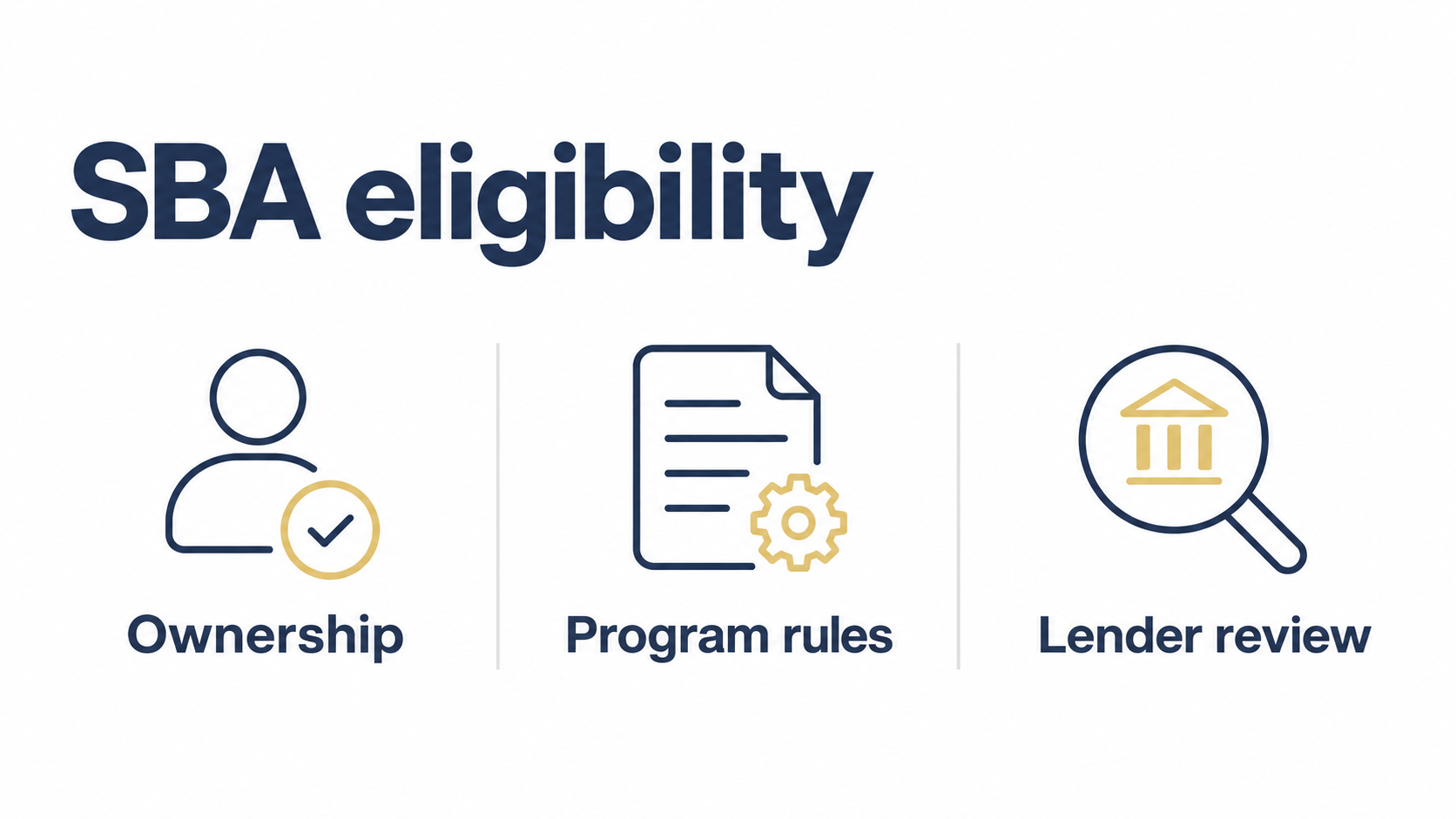
Why the full ownership chart matters
A citizen majority owner does not resolve an ineligible minority stake
The SBA citizenship requirements apply through the ownership chain. A U.S.-registered LLC or corporation does not resolve the issue when an ineligible person owns an interest through a holding company. Entity owners must also meet the domestic-formation requirements.1
For illustration, consider a proposed acquisition owned 95% by a U.S. citizen and 5% by a green card holder. The citizen’s majority stake does not satisfy a 100% eligible-ownership test. Similarly, do not confuse ownership eligibility with the separate ownership thresholds used to determine who must provide a personal guaranty.
Before discussing a loan amount, prepare a simple ownership chart showing the borrower, any holding companies, each ultimate individual owner and the percentage held at every level. For a real estate transaction, identify the property-owning and operating entities separately.
Changing ownership needs a real transaction review. SBA guidance allows a transaction to proceed after an ineligible owner completely divests before issuance of the SBA loan number, subject to the applicable rules. Ask the lender and transaction advisers to review any proposed sale or restructuring before relying on it as a financing solution.4
Guarantor rules have additional nuances, including permitted limited or supplemental guarantees in specified circumstances. A guarantee exception does not create an ownership exception.
Approval dates and servicing
What about an SBA loan approved before March 1, 2026?
SBA guidance permits continued servicing of earlier approved loans. It does not automatically cancel them because an owner is now in an excluded category. However, an increase cannot proceed if the applicant fails the revised citizenship and residency rules; changes involving owners or required guarantors also need review.4
For transition files, a lender conversation or an application draft is not enough to establish which rules apply. The February procedural notice distinguishes delegated loans by issuance of the SBA loan number and non-delegated files by entry into R1 status in E-Tran, with a specified February 28 cutoff for the latter.3
Ask your lender to confirm the recorded approval or processing status, the applicable date, and whether your request is routine servicing, an increase, a new loan or a change of ownership. Keep that confirmation with the financing documents.
Build the right financing plan
What should an immigrant business owner do next?
Once the ownership question is resolved, the next task is to build a financing plan around a product the business can actually pursue. We recommend the following sequence when preparing a funding case.
Confirm the financing route
Give the lender the full ownership structure and describe the transaction. Ask for an initial eligibility review before making an offer, signing a lease or setting a closing date that depends on financing.
Test alternatives if SBA is unavailable
Ask about conventional bank loans, non-SBA community-lender products, seller financing, equipment finance or investor equity. Availability and terms depend on the provider and the business; compare the required contribution, collateral, repayments and effect on ownership.
Make the funding request specific
Separate the purchase price or startup investment from fees, equipment, improvements, inventory and working capital. Show how owner funds and proposed financing cover the total project cost.
Support repayment with realistic projections
Connect sales assumptions to customers, prices and delivery capacity. Include operating costs, cash timing, owner compensation and debt payments, then test a slower start or lower sales before presenting the forecast.

For eligible applicants, our SBA business plan service helps organize that case for lender review. For a different financing route, a bank loan business plan can be tailored to the proposed lender and transaction.
For E-2 and EB-5 investors: assess the business financing and immigration strategy together with the appropriate advisers. A financing product that works commercially should also be reviewed for its implications for the immigration case. Neither an investment nor a pending citizenship application substitutes for current qualifying status.7
Common questions
SBA loans, green cards and citizenship: FAQs
Can green card holders get an SBA loan in 2026?
For new 7(a) and 504 applications covered by the rules effective March 1, 2026, a business cannot have any direct or indirect green-card ownership. SBA Microloans have a comparable ownership restriction effective April 1, 2026. Earlier approved loans and transition cases require separate lender review.
Can immigrants who have become U.S. citizens still qualify?
Yes. Naturalized U.S. citizens can qualify, subject to the residency, ownership, business and credit requirements. Being born outside the United States does not by itself disqualify a borrower. Dual-citizenship situations can require additional lender review.
Does a U.S.-citizen majority owner solve the problem?
No. A U.S.-citizen majority does not satisfy the current 100% ownership requirement if an ineligible person retains a direct or indirect stake.
Can an E-2 investor or an EB-5 green card holder qualify as an owner?
An E-2 visa holder does not qualify as an eligible owner under the current citizenship rules. Conditional and unconditional lawful permanent residents are also excluded. An EB-5 petition or investment does not itself establish U.S. citizenship.
Can a bank make an exception to the SBA citizenship requirements?
A participating lender cannot waive SBA program eligibility rules. Ask whether a separate conventional loan product is available and what eligibility, collateral, equity and repayment conditions apply.
What if my SBA loan was approved before March 1, 2026?
The rule change does not automatically cancel an earlier approved loan. SBA guidance permits continued servicing, but increases and ownership or guarantor changes can trigger additional requirements. Have the lender confirm the rules for the requested action.
Answers summarize the official sources below. Confirm the current rule and transaction details with your lender.
Business planning for your next financing step
How Mikel Consulting can help you prepare for business financing
If SBA financing is unavailable, you may still need a strong business plan and financial model to approach another lender, negotiate with a seller or present your business to investors. Mikel Consulting prepares those materials around your proposed financing route, business model and transaction.
For businesses pursuing SBA financing: once your lender has confirmed initial eligibility, we prepare a lender-facing business plan with market research, a clear funding request, detailed use of funds and financial projections showing how the business expects to meet its operating costs and loan repayments.
For owners exploring other financing: we tailor the plan and projections for conventional bank loans, seller-financed acquisitions or private investment. The model can compare proposed repayment terms, owner contributions and working capital needs, or show investors how their capital will be used to support the business.
For entrepreneurs buying an existing business: we bring the purchase price, transaction costs, planned improvements and cash reserves into one funding model. We then assess the proposed debt payments against the business’s projected cash flow, including a slower-sales scenario, to help you evaluate affordability before committing.
Your lender determines financing eligibility and approval. Our role is to make the business case clear, support the numbers with realistic assumptions and prepare materials that help lenders or investors evaluate the opportunity.
Planning a startup, buying a business or funding an expansion?
Tell us about the business, the amount you need and the financing route you are considering. We will outline the business plan and financial projections needed for your next lender or investor conversation.
Discuss your business and funding plansPrimary-source review
Official sources
- U.S. Small Business Administration, SOP 50 10 8.1 with Technical Policy Updates, effective October 1, 2026; Section A, Chapter 1, Paragraph F and Appendix 3. Reviewed October 21, 2026.
- SBA, Policy Notice 5000-876441: Update to Citizenship and Residency Requirements, published February 2, 2026; effective March 1, 2026.
- SBA, Procedural Notice 5000-876626: Revised Applicant Ownership, Citizenship, and Residency Requirements for 7(a) and 504 Loans, published February 11, 2026; effective March 1, 2026.
- SBA, Information Notice 5000-877673: Guidance for Frequently Asked Questions Related to Recent SBA Procedural Notices, published March 31, 2026; citizenship and residency questions 1–6.
- SBA, Procedural Notice 5000-877356: Updated Microloan Program Citizenship Requirements, published March 13, 2026; effective April 1, 2026.
- SBA, 7(a) loans, program overview and general eligibility requirements. Accessed October 21, 2026.
- U.S. Citizenship and Immigration Services, Naturalization: What to expect, citizenship and Oath of Allegiance. Accessed October 21, 2026.
This article provides general educational information as of October 21, 2026. It is not legal, immigration, tax or individualized lending advice. SBA policies and lender requirements can change. Confirm eligibility and transaction requirements with the lender and qualified advisers. Mikel Consulting prepares business plans and financial models; it does not determine SBA eligibility or guarantee financing.