

U.S. Business Expansion Support
L-1 Visa Business Plans for New Office and Established Office Petitions
Build the Case for Your U.S. Expansion
Present a clear L-1 business plan explaining the relationship between the foreign and U.S. entities, the purpose of the expansion, and the transferee’s executive, managerial, or specialized-knowledge role. Our plans support both new-office and established-office strategies with detailed operations, staffing, and financial projections.
L-1 Visa Business Plan Package
Includes:
- L-1A or L-1B-focused business plan
- Foreign and U.S. company relationship narrative
- Transferee role and organizational structure
- Expansion strategy, hiring plan, and financial forecast
L-1 Business Plan Overview
What USCIS Looks For in a New Office L-1A Business Plan
A new office L-1A petition can initially be approved for up to one year. With no U.S. operating history, the business plan helps explain how the new office will meet three key requirements:
- Test One: Physical premises. Show that suitable U.S. premises have been secured. The plan’s address and space details should agree with the lease or other supporting evidence.
- Test Two: Qualifying employment abroad. Show that the beneficiary worked abroad in an executive or managerial capacity for one continuous year within the relevant three-year period. Describe that role accurately and consistently with the employment evidence.
- Test Three: A managerial or executive role within one year. Explain how the U.S. office’s staffing, operations, and growth will support that role within one year of approval.
Because USCIS reviews the new office’s progress at the extension stage, we write first-year staffing and financial targets the company can realistically meet.
Mikel Consulting Record of Success
Trusted by entrepreneurs, immigration professionals, and clients across 90+ countries
How We Work With Your Immigration Attorney
We prepare the business, market, operational, staffing, and financial components of the petition. Your immigration attorney remains responsible for eligibility, petition strategy, legal argument, and filing decisions. We are not a law firm and do not give immigration advice.
- We work directly from your attorney’s redlines and return revised drafts within 7 business days.
- If an RFE is issued on business plan content, we revise the plan at no additional cost.
200+ law firms and immigration professionals have worked with Mikel Consulting on business plan support.
L-1 Program Snapshot
Understanding L-1 Intracompany Transfers
What the L-1 classification is used for
The L-1 classification allows a qualifying organization to transfer an eligible employee from a related foreign operation to a U.S. parent, branch, subsidiary, or affiliate.
It can support executive and managerial L-1A transfers or L-1B transfers involving qualifying specialized knowledge.
Temporary intracompany transfer classification covering L-1A and L-1B beneficiaries.
The foreign and U.S. entities must have a qualifying parent, branch, subsidiary, or affiliate relationship.
The beneficiary generally needs one continuous year of qualifying foreign employment within the applicable three-year period.
The petition may involve a new U.S. office or an established business with active operations.
Foreign company history, U.S. expansion, transferee role, premises, staffing, operations, and financial capacity.
L-1 Business Plan Requirements
What a Strong L-1 Business Plan Should Demonstrate
An L-1 business plan should explain the relationship between the foreign and U.S. organizations, the purpose of the U.S. operation, and how the proposed transferee will perform qualifying executive, managerial, or specialized-knowledge duties.
The plan should connect the multinational organization, U.S. expansion, transferee’s background and duties, staffing structure, operating milestones, and financial capacity.
Qualifying Relationship
Clear explanation of the ownership and control connecting the foreign and U.S. entities as a parent, branch, subsidiary, or affiliate.
Foreign Operations
Evidence of the foreign company’s active operations, history, organizational structure, financial position, and qualifying employment of the transferee.
U.S. Expansion Strategy
A practical roadmap covering premises, investment, launch or expansion activities, services, customers, operating requirements, and commercial milestones.
Qualifying U.S. Role
Duties and decision-making authority consistent with an L-1A executive or managerial position or an L-1B specialized-knowledge role.
Organization & Hiring
Organizational charts, staffing milestones, reporting relationships, and operational support showing how the proposed role will function.
Financial Capacity
Investment, revenue, expenses, payroll, cash flow, and funding projections demonstrating the organization’s capacity to establish and support the U.S. operation.
Service Details
L-1 Visa Business Plan Delivery Details
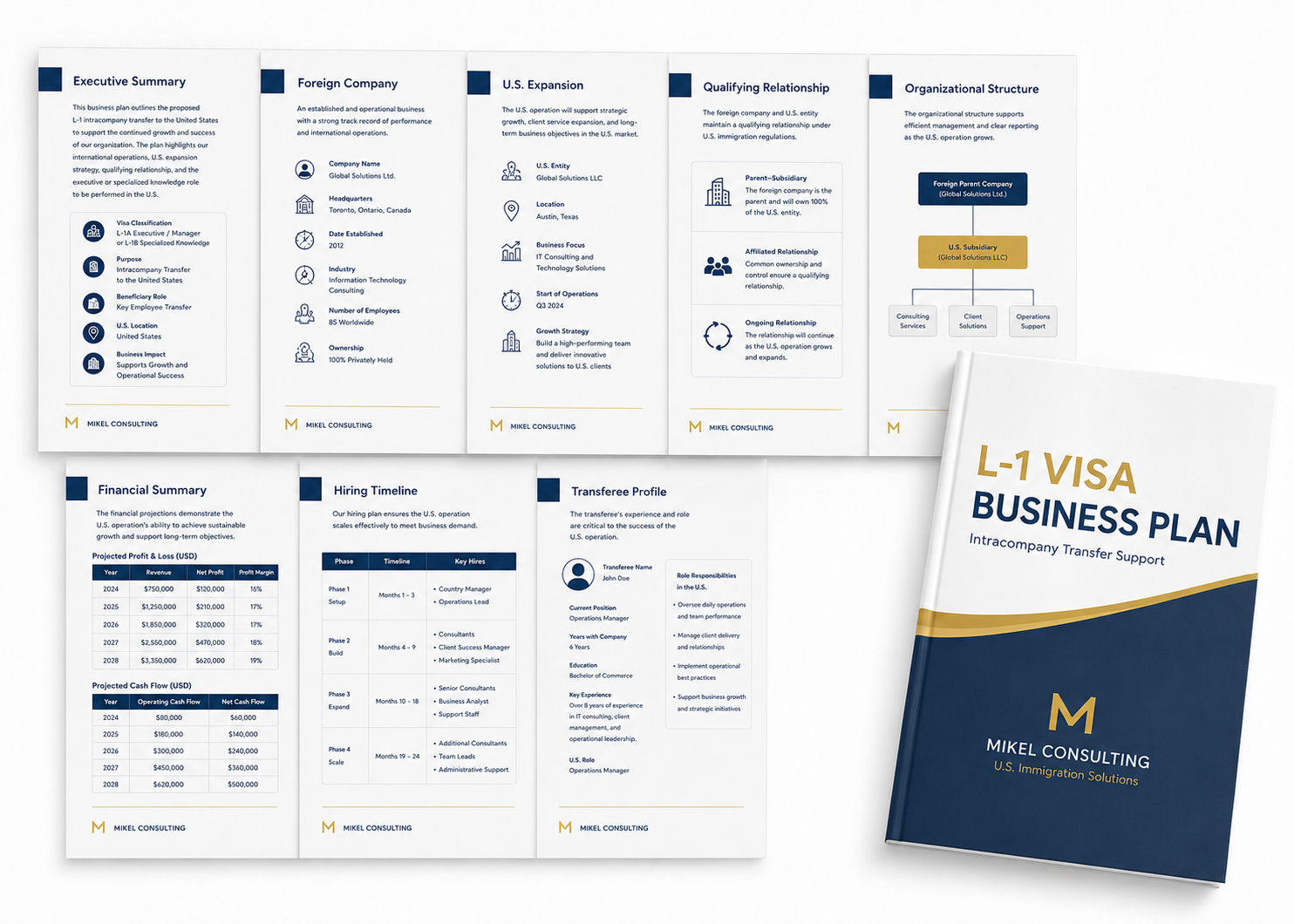
Sample Document Preview
Professional, L-1-Focused Formatting
L-1 business plans can include the foreign company profile, qualifying corporate relationship, U.S. expansion strategy, transferee role, organizational charts, staffing milestones, market analysis, operating plan, and financial projections.
Our Process
How Our L-1 Business Plan Process Works
Intro Call or Email
We discuss the foreign company, U.S. operation, corporate relationship, proposed transferee, petition category, and timeline.
Engagement Process
We confirm the scope, complete onboarding, and provide a structured request for company, expansion, applicant, and financial information.
Information Review
Our team reviews the foreign and U.S. entities, transferee history, proposed duties, staffing structure, and operating assumptions.
Plan Development
We prepare the L-1 business plan, U.S. market research, expansion strategy, organizational plan, and financial forecast.
Review & Revisions
You and your legal team review the draft, and we refine it for accuracy, consistency, and petition alignment.
Final Delivery
The final L-1 business plan is delivered in polished PDF and editable formats.
Why Mikel Consulting
Why Work With Mikel Consulting for Your L-1 Business Plan?
We combine multinational company analysis, U.S. expansion planning, organizational development, market research, and financial projections into one clear L-1 business plan.
L-1-Focused Business Plans
We structure the plan around the foreign company, qualifying corporate relationship, U.S. operation, transferee role, organizational plan, staffing milestones, and financial forecast.
Experience With U.S. Expansion
We know how to present new offices, established operations, L-1A leadership positions, L-1B specialized-knowledge roles, and multinational growth strategies clearly.
Attorney-Friendly Drafting Process
We can work alongside your U.S. immigration attorney and revise the plan based on legal feedback, corporate documentation, role analysis, and petition strategy.
Financial and U.S. Market Research
We combine market research, U.S. operating assumptions, investment, staffing, payroll, organizational growth, and financial projections into one cohesive document.
Sample L-1 Business Plans
L-1 Business Plan Examples for U.S. Company Expansion
L-1 Visa Sample
Jewelry Wholesale
An L-1 business plan example for a luxury-goods, wholesale, retail, and import company entering the U.S. market through a related American operation.
View Plan →L-1 Visa Sample
Pharmacy Wholesale
An L-1 business plan example for a health-products and import-export enterprise, presenting the multinational operation, executive role, U.S. expansion, staffing, and financial outlook.
View Plan →More U.S. Immigration Examples
Browse Our Sample Library
Explore additional business plan examples prepared for U.S. investor, expansion, national-interest, and employment-based immigration programs.
Browse U.S. Examples →L-1 Business Plan Support
Let’s Build Your L-1 Business Plan
Complete the form and one of our senior consultants will review your inquiry within 24 hours. For time-sensitive L-1 business plan support, call or message us directly.
🔒 Your information is strictly confidential. We do not share your details with third parties.
L-1 Visa Business Plan FAQ
Frequently Asked Questions
Current guidance for L-1A, L-1B, new-office, expansion, ownership, staffing, and intracompany transfer business plans.
What is the L-1 intracompany transferee classification?
The L-1 classification allows a qualifying international organization to transfer an eligible employee from a related foreign entity to a U.S. parent, branch, subsidiary, or affiliate. L-1A applies to executives and managers, while L-1B applies to employees with qualifying specialized knowledge. The petitioning organization, corporate relationship, foreign employment, proposed U.S. position, and continuing business operations must independently satisfy the applicable requirements.
What is the difference between L-1A and L-1B?
L-1A is intended for employees who will primarily perform executive or managerial duties in the United States. L-1B is intended for employees with specialized knowledge concerning the organization’s products, services, research, equipment, techniques, management, processes, or other qualifying interests. Job titles alone are insufficient; the petition must explain the beneficiary’s actual duties, authority, organizational placement, and qualifying knowledge.
What corporate relationship is required for an L-1 petition?
The U.S. petitioner and the qualifying foreign organization must generally have a parent, subsidiary, branch, or affiliate relationship involving qualifying ownership and control. Documents may include incorporation records, share registers, operating agreements, organizational charts, financial records, and other evidence tracing ownership and control. A commercial relationship, vendor arrangement, or shared brand without qualifying ownership and control is generally not enough.
How much qualifying foreign employment is required?
The beneficiary generally must have worked abroad continuously for a qualifying organization for at least one year within the relevant three-year period. The foreign employment must have been in a qualifying executive, managerial, or specialized-knowledge capacity, depending on the requested classification. Travel and periods in the United States can affect how the qualifying period is calculated, so the exact employment history should be reviewed by counsel.
What is an L-1 new office petition?
A new-office petition is used when the qualifying international organization is establishing or has recently established a U.S. office that has been doing business for less than one year. The petitioner must generally show sufficient physical premises, a qualifying organizational relationship, and a credible ability to commence operations. For L-1A, the evidence must also show that the office will support an executive or managerial position within one year of approval.
Why is a business plan especially important for an L-1A new office?
A new office has limited operating history, so the business plan helps explain how the U.S. company will launch, obtain customers, generate revenue, hire personnel, and develop an organizational structure capable of supporting the beneficiary’s executive or managerial role. The plan should connect the first-year timetable, investment, premises, operating activities, staffing, and financial forecast to the duties described in the petition and supporting evidence.
What should an L-1 business plan include?
An L-1 business plan commonly includes the foreign and U.S. company histories, qualifying relationship, ownership, products or services, U.S. market opportunity, premises, investment, launch or expansion schedule, organizational structure, employee positions, beneficiary duties, marketing strategy, operating plan, and financial projections. A new-office plan should provide particularly detailed first-year milestones and show how operational staff will relieve an L-1A beneficiary from primarily performing routine day-to-day tasks.
Can a small company qualify for an L-1A visa?
A small organization is not automatically disqualified, but USCIS evaluates whether the company’s reasonable needs and organizational structure support a genuinely executive or managerial position. In a very small business, evidence must carefully distinguish strategic leadership from primarily operational work. The company’s stage of development, staffing, contractors, complexity, professional functions, revenue, and realistic hiring schedule may all be relevant.
Does an L-1A manager have to supervise employees?
Not always. A personnel manager generally supervises and controls the work of professional employees or manages an essential department, subdivision, or component with qualifying authority. A function manager may manage an essential function at a senior level without directly supervising employees. In either case, the petition must establish the nature of the managerial role rather than relying on a title or generalized job description.
Does an L-1 company need a physical U.S. office?
A new-office petitioner must generally show that sufficient physical premises have been secured to house the proposed operation. What is sufficient depends on the business model, staffing, location, and anticipated activities. A professional service company may have different requirements from a warehouse, restaurant, clinic, or manufacturing operation. The premises should be consistent with the plan, lease documentation, hiring schedule, and operational needs.
Can the transferred employee own the U.S. or foreign company?
Ownership by the beneficiary does not automatically prevent L-1 eligibility. The entities must still have the required qualifying relationship, conduct qualifying business, and employ the beneficiary in the required capacity. In an owner-beneficiary case, the evidence should clearly document the corporate structure, control, ongoing foreign operations, temporary nature of the requested stay where applicable, and the practical distinction between ownership and the qualifying U.S. role.
How long can a person remain in L-1 status?
An L-1A manager or executive may generally receive up to seven years of L-1 stay, while an L-1B specialized-knowledge employee may generally receive up to five years. A qualifying new-office beneficiary is normally granted an initial period of up to one year; other qualifying petitions may receive longer initial validity. Time previously spent in certain H or L classifications can affect the maximum period available.
Can an L-1 visa lead to permanent residence through EB-1C?
Some L-1A beneficiaries may later qualify as EB-1C multinational executives or managers, but L-1A approval does not automatically establish EB-1C eligibility. EB-1C is a separate immigrant classification with its own requirements, including a qualifying U.S. petitioner that has generally been doing business for at least one year. The permanent position, foreign employment, corporate relationship, and managerial or executive evidence are evaluated separately.
Can an L-1 beneficiary bring a spouse and children?
A qualifying spouse and unmarried children under 21 may generally seek L-2 status. Qualifying L-2 spouses are generally employment authorized incident to status when properly documented, while L-2 children are not employment authorized merely because of dependent status. The duration of dependent status is normally tied to the principal L-1 beneficiary’s authorized stay.
Can you work with an attorney we have already retained?
Yes. We regularly work with clients’ immigration attorneys. We take direction from counsel, align the business plan with the petition strategy and supporting evidence, and deliver an editable file so their office can adjust wording. Your attorney remains responsible for eligibility, legal arguments, and filing decisions.
How much does an L-1 visa business plan cost?
Our L-1 visa business plans start at $1,500 USD. Plans are typically 35–45 pages and generally completed within 7 business days after all required company, ownership, applicant, market, staffing, and financial information is received. Unlimited revision support is included for factual corrections, attorney feedback, application alignment, and final refinement.
How many new-office L-1A business plans have you written in the last twelve months?
Mikel Consulting has prepared 10+ new-office L-1A business plans in the past twelve months. Each plan is tailored to the company’s qualifying relationship, U.S. launch, staffing schedule, beneficiary role, and financial projections.
Can I see a redacted L-1 new-office sample?
Yes. We can provide redacted L-1A new-office and L-1B specialized-knowledge samples on request, so you can see how we present the qualifying relationship, first-year staffing plan, and beneficiary role. Contact us to request a sample.
Who actually writes the plan: a named consultant or a pool?
A named Mikel Consulting consultant is assigned to your file and stays with it through revisions. You can speak with that consultant directly throughout the project.
Why is your L-1 plan 35–45 pages when some providers deliver 8–12?
The petition-facing narrative can be concise. Our full document also includes detailed financial projections, organizational charts, market research, and an index of supporting exhibits. We can provide a condensed petition-facing version alongside the full plan if your attorney prefers.
What happens if we receive an RFE about the business plan?
If a Request for Evidence (RFE) concerns business plan content, we revise the relevant sections at no additional cost and work from your attorney’s response strategy. Your attorney handles the legal response and filing.
How do you handle the one-year extension?
We build realistic first-year staffing, operating, and revenue targets into the initial plan. For an extension, your attorney will need evidence of the U.S. office’s actual operations, staffing, beneficiary duties, and financial status. We can help update the business and financial narrative to reflect the company’s progress and any changes from the original plan.
Do you guarantee approval?
No. USCIS decides whether to approve the petition. We are responsible for preparing a clear, accurate, and internally consistent business plan that aligns the operating, staffing, and financial information with the evidence supplied by you and your attorney.
Additional Support
Related U.S. Immigration Business Plan and Legal Support
Need a U.S. Immigration Lawyer?
We can connect you with a vetted U.S. immigration lawyer experienced in investor, entrepreneur, business expansion, and employment-based applications.
Request a ReferralAre You an Immigration Lawyer?
Join our partner network and provide your clients with professionally prepared business plans, financial projections, market research, and revision support.
Join Our Partner Program