

U.S. Fashion Business Planning
Fashion Line & Boutique Business Plan Services
Custom plans for fashion designers, apparel brands, boutiques, e-commerce retailers, manufacturers, and luxury or lifestyle concepts.
We prepare business plans for fashion lines and fashion boutiques seeking SBA and conventional loans, private investment, inventory financing, commercial leases, manufacturing partnerships, or expansion. Each plan connects the brand concept, product strategy, sourcing, sales channels, marketing plan, funding needs, and projected financial performance.
A Plan Built Around Your Brand, Products, Sales Channels, and Funding
Can Include:
- Fashion line, boutique, e-commerce, or wholesale model
- Collections, pricing, margins, inventory, and sales cycles
- Sourcing, manufacturing, suppliers, and fulfillment
- Market positioning, funding request, and five-year projections
Fashion Line & Boutique Overview
Fashion Business Plans That Connect Brand, Product, Inventory, and Growth
A fashion business plan explains the brand concept, target customer, products, collections, sourcing, manufacturing, pricing, inventory, wholesale, e-commerce or retail channels, marketing, team, funding requirement, and financial outlook. It gives lenders, investors, landlords, manufacturers, and partners a structured view of how the fashion company will launch and grow.
Mikel Consulting Track Record
Supporting fashion entrepreneurs preparing to launch brands, open boutiques, and expand sales channels
Fashion Businesses Supported
Fashion Businesses We Support
Fashion Line and Boutique Business Types We Support
Fashion Lines & Apparel Brands
A fashion line business plan covering brand identity, target customer, collections, product development, sourcing, manufacturing, pricing, inventory, launch strategy, and sales channels.
Fashion Boutiques
A fashion boutique business plan for physical stores covering merchandise mix, location, target shopper, buying, inventory turns, store design, staffing, marketing, and retail sales.
Online Fashion Stores
An online fashion boutique business plan for direct-to-consumer e-commerce, website sales, marketplaces, digital advertising, fulfillment, returns, customer acquisition, and repeat purchasing.
Wholesale Fashion Labels
A wholesale fashion business plan for brands selling through boutiques, department stores, distributors, showrooms, trade events, seasonal orders, production cycles, and retailer margins.
Luxury Fashion Brands
A luxury fashion business plan covering premium positioning, craftsmanship, limited production, high-value products, selective distribution, brand storytelling, client relationships, and international growth.
Accessories & Footwear Brands
A fashion accessories business plan for handbags, jewelry, footwear, eyewear, hats, leather goods, or related products with specialized sourcing, pricing, inventory, and channels.
Sustainable Fashion Companies
A sustainable fashion business plan for ethical sourcing, recycled or low-impact materials, circular models, local production, resale, transparency, and environmentally focused consumers.
Multi-Channel Fashion Businesses
A combined fashion line and boutique business plan connecting owned-brand products, third-party merchandise, wholesale accounts, e-commerce, pop-ups, and permanent retail locations.
Business Plan Content
What Your Fashion Line & Boutique Business Plan Includes
Each plan is customized to your brand, products, sales channels, funding purpose and growth strategy.
Market & Competitive Analysis
Target customers, fashion spending and category trends, together with an assessment of boutiques, direct-to-consumer labels and marketplaces.
Business Model & Collections
Retail, e-commerce, wholesale, pop-ups or private-label sales, including product categories, prices and gross margins.
Operations & Sourcing
Design, sampling, supplier relationships, production, inventory planning, fulfillment and returns.
Marketing Strategy
Brand storytelling, social commerce, influencers, email marketing, events and customer retention.
Management & Staffing
Creative direction, buying, store employees, e-commerce, marketing and fulfillment support.
Financial Plan & Implementation
Units sold, sales-channel mix, product costs, markdowns, inventory funding, cash flow and launch milestones.
Sample Fashion Line & Boutique Plan Preview
Professional, Decision-Ready Formatting
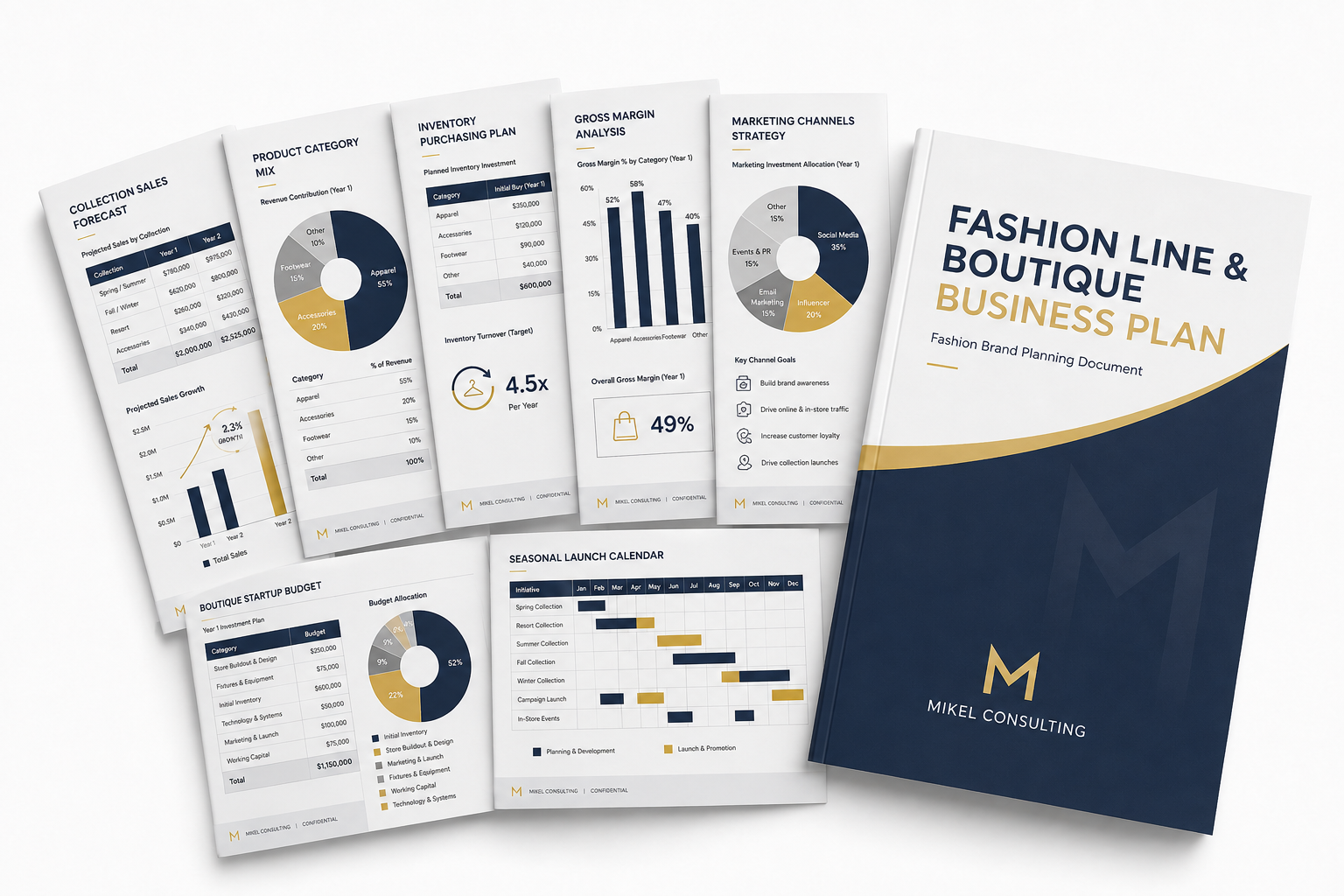
Your fashion line or boutique business plan connects brand identity with product economics, inventory planning and customer acquisition.
Funding and Planning Uses
Fashion Line and Boutique Business Plans for Financing and Investors
A fashion business plan can support inventory financing, an SBA loan, investor discussions, immigration applications, a boutique opening or the launch and expansion of a fashion brand.
Bank Loan Business Plans
Support financing for inventory, production, retail improvements, fixtures, e-commerce development, marketing and working capital.
Explore Bank Loan Plans For SBA FinancingSBA Loan Business Plans
Prepare an SBA-focused plan for launching, acquiring or expanding a fashion boutique, clothing line, e-commerce brand or apparel business.
Explore SBA Loan Plans For Equity CapitalInvestor Business Plans
Present the brand identity, target customer, product strategy, distribution channels, funding requirement and potential for scalable growth.
Explore Investor Plans For Visa ApplicationsImmigration Business Plans
Explain the U.S. investment, fashion or retail concept, owner’s management role, sourcing strategy, staffing plan and expected business growth.
Explore Immigration Plans For ForecastingFinancial Modeling
Forecast unit sales, product margins, wholesale and retail channels, inventory purchases, returns, marketing, staffing and cash flow.
Explore Financial Models For Market DecisionsFeasibility Studies
Evaluate target customers, pricing, competitors, retail locations, online demand, sourcing costs, distribution options and projected financial viability.
Explore Feasibility StudiesFashion Business Plan Guide
How to Write a Fashion Business Plan for Funding and Brand Growth
A strong fashion line or boutique business plan should connect the brand, target customer, product strategy, sourcing, inventory requirements, sales channels and financial projections.
Define the Brand and Target Customer
Explain the brand identity, style, price point and value proposition. Define the target customer using demographics, lifestyle, purchasing behavior and the problem or need the products address.
Research Fashion Demand and Competition
Analyze customer spending, category trends, retail conditions and relevant sales channels. Compare boutiques, direct-to-consumer brands, marketplaces and established labels.
Develop the Product and Pricing Strategy
Define product categories, collections, seasonal releases, retail prices and wholesale prices. Calculate product costs, gross margins and the expected mix of sales.
Explain Sourcing and Inventory Operations
Describe design, sampling, suppliers, production lead times, minimum orders, quality control, fulfillment and returns. Explain how inventory levels and markdown risks will be managed.
Build the Sales and Marketing Strategy
Explain how e-commerce, retail, wholesale, social commerce, influencers, email and events will build awareness and generate sales. Connect marketing spending to measurable customer acquisition.
Prepare Financial and Funding Projections
Forecast units sold, channel mix, product costs, inventory, payroll, marketing, markdowns and cash flow. Identify funding for production, store improvements, e-commerce and working capital.
Our Process
How Our Fashion Line & Boutique Business Plan Process Works
Discovery
We review your brand, collection, customers, sales channels and funding purpose.
Engagement
You receive a contract, make payment and complete our structured intake questionnaire.
Information Review
We review your products, prices, suppliers, inventory plans and sales-channel strategy.
Research & Financials
We assess customer demand and competitors and model sales, margins, inventory and cash flow.
Draft & Revisions
You review the draft and we refine the plan for accuracy, clarity and funding readiness.
Final Delivery
You receive polished PDF and editable files ready for your intended audience.
Why Mikel Consulting
Why Work With Mikel Consulting for Your Fashion Business Plan?
We combine fashion-industry research, brand strategy and detailed financial forecasting into a professional plan built around your products, customers, sales channels and funding objectives.
Fashion Market Research
We assess target customers, fashion spending, product trends, retail conditions and competing boutiques or brands.
Brand-Specific Strategy
We present your collections, pricing, sourcing, production, inventory, sales channels and approach to building the brand.
Integrated Financial Projections
Our forecasts connect units sold, sales-channel mix, product costs, margins, inventory cycles, markdowns and cash flow.
Senior Consultant Involvement
Your plan is developed and reviewed by experienced consultants who understand consumer brands, inventory planning and financing.
Fashion Business Plan Examples
Explore Bank Loan and Investor Business Plan Examples
These general examples demonstrate the market research, funding presentation, growth strategy and financial projections we adapt for a fashion line or boutique business plan.
Bank Loan Business Plan Example
Restaurant Bank Loan Plan
Review how a location-based business presents startup costs, capital requirements, use of funds, operating strategy and repayment projections.
Investor Business Plan Example
Environmental Consulting
See how a growth-stage company presents its market opportunity, brand positioning, expansion strategy, funding request and investor potential.
More Business Plan Examples
Browse Our Sample Library
Explore additional business plans, financial models, feasibility studies and other professional planning documents.
Fashion Line & Boutique Business Plan Support
Let’s Discuss Your Fashion Business Plan
Complete the form with your fashion line or boutique concept, products, sourcing and sales channels, location if applicable, funding purpose, launch plans, and preferred timeline. One of our senior consultants will review your inquiry within 24 hours. For a time-sensitive investor, financing, or lease opportunity, call or message us directly.
🔒 Your information is strictly confidential. We do not share your details with third parties.
Fashion Line & Boutique Business Plan FAQ
Frequently Asked Questions About Fashion Line and Boutique Business Plans
What should a business plan for a fashion line include?
A business plan for a fashion line should explain the brand concept, target customer, product categories, collection strategy, design and development process, sourcing, manufacturing, minimum order quantities, pricing, inventory, sales channels, marketing, team, launch schedule, and growth strategy. It should clarify whether the company sells direct to consumers, through wholesale accounts, marketplaces, pop-ups, permanent retail, or a combination.
The financial section should connect styles, units, selling prices, product costs, gross margins, production deposits, inventory timing, marketing, staffing, and working capital.
What should a business plan for a fashion boutique include?
A fashion boutique business plan should cover the retail concept, merchandise mix, target shopper, location or e-commerce strategy, buying process, brands carried, pricing, inventory turns, store layout, staffing, customer experience, promotions, and expansion plans. It should distinguish owned-brand products from third-party merchandise where both are sold.
The forecast should be built from traffic, conversion, transactions, average order value, channel mix, seasonal buying, markdowns, returns, product costs, occupancy expenses, payroll, and marketing.
Can one plan cover both a fashion line and a boutique?
Yes. A combined plan can cover a proprietary fashion line sold through the company’s boutique, website, wholesale accounts, and external marketplaces. The key is to separate the economics of product development and manufacturing from the economics of retail distribution.
The plan should identify transfer or product costs, channel-specific selling prices, wholesale discounts, retail margins, inventory ownership, returns, and the amount of capital tied up at each stage.
How should fashion inventory and seasonal collections be forecast?
The model should track product categories, styles or collections, unit quantities, landed cost, selling price, launch timing, sell-through, markdowns, returns, and remaining inventory. Production deposits and supplier payment terms should be reflected because cash often leaves the business well before customer sales occur.
A credible forecast allows for slower-selling items, replenishment of successful products, end-of-season discounting, sampling, damaged goods, and the working capital required to fund the next collection.
Can a fashion business plan support investors, loans, or a retail lease?
Yes. The plan can support SBA or conventional financing, private investors, inventory or purchase-order funding, equipment needs, commercial lease discussions, and brand expansion. The appropriate funding source depends on operating history, collateral, purchase orders, margins, owner investment, and the intended use of funds.
The plan should explain exactly how capital will be used for development, sampling, production, inventory, deposits, store improvements, technology, payroll, marketing, and working capital and how those expenditures support sales.
What market research belongs in a fashion business plan?
The analysis should define the target customer, style and price position, relevant apparel or accessory category, shopping behavior, competing brands and boutiques, sales channels, trends, and the specific gap the business intends to fill. For a physical boutique, local demographics, traffic, neighboring retailers, rent, parking, and trade area are also important.
The plan should avoid treating the entire apparel market as the addressable opportunity. It should connect the brand’s design, price, channel, customer-acquisition strategy, and attainable sales volume.
What are common weaknesses in a fashion business plan?
Common weaknesses include underestimating minimum orders and production deposits, assuming all inventory sells at full price, overlooking returns and markdowns, using unrealistic customer-acquisition costs, and launching too many styles or channels at once. Other problems include weak supplier planning, no quality-control process, insufficient working capital, and forecasts that ignore the timing difference between production and sales.
A strong plan connects product strategy, sourcing, inventory, channels, margins, marketing, capital needs, and cash flow.
What information does Mikel Consulting need to prepare a fashion line or fashion boutique business plan?
We typically request information about your brand concept, product categories, collections, pricing, target customer, sourcing and manufacturing, order quantities, inventory, wholesale accounts, e-commerce or retail channels, location if applicable, marketing, team, launch budget, financing request, and any historical sales or financial statements. The exact list depends on whether the project involves a startup, acquisition, expansion, financing request, investor presentation, licensing process, or internal planning.
Not every decision must be final before work begins. Our intake process helps identify gaps, and reasonable assumptions can be developed where information is still being confirmed. The client remains responsible for verifying ownership, legal, regulatory, transaction, and financial information before the plan is submitted or relied upon.
How long does a fashion line or fashion boutique business plan take, and what does it cost?
Our U.S. fashion line and fashion boutique business plans currently start at $1,000 USD. A typical first draft is delivered within 7 to 10 business days after we receive the required information. More complex developments, acquisitions, multi-location operations, specialized research, extensive financial cleanup, or urgent deadlines may require a custom scope, price, and schedule.
The service includes research, written strategy, financial projections, professional formatting, and revision support for 30 days after the first draft. Final delivery can include a polished PDF and editable working files.
Can a professionally prepared fashion line or fashion boutique business plan guarantee financing or approval?
No. A professional plan can improve how the business, market opportunity, operating strategy, funding requirement, and financial projections are presented, but it cannot guarantee a decision by a lender, investor, landlord, manufacturer, wholesale partner, or other reviewer. Outcomes depend on the complete application, applicant qualifications, credit and financial position, available capital, collateral where relevant, regulatory eligibility, market conditions, and the reviewer’s independent criteria.
Mikel Consulting’s role is to develop a credible, internally consistent plan, identify unsupported assumptions, and communicate the business case clearly. The relevant lender, investor, agency, landlord, or other decision-maker remains solely responsible for its review and decision.