

Financial Forecasting & Analysis
Financial Models
Custom Excel financial models for fundraising, lending, valuation, budgeting, and strategic decision-making.
Turn your business assumptions into a transparent, decision-ready financial model. We build customized forecasts that connect revenue drivers, operating expenses, staffing, capital requirements, cash flow, profitability, and funding needs so you can evaluate scenarios and communicate your financial outlook with confidence.
Built for Funding, Planning, and Financial Decisions
Includes:
- Integrated income statement, cash flow, and balance sheet
- Revenue, expense, and staffing assumptions
- Break-even and sensitivity analysis
- Valuation, WACC, and IRR analysis when applicable
Financial Model Overview
Custom Financial Models for Funding, Forecasting, and Strategic Decisions
A financial model translates business assumptions into an integrated forecast of revenue, expenses, profitability, cash flow, assets, liabilities, and funding requirements. A well-structured model helps decision-makers understand how the business may perform, which variables matter most, and how different operating or financing scenarios could affect the outcome.
Mikel Consulting Track Record
Financial planning experience supporting businesses across industries and growth stages
Financial Model Applications
Service Details
Financial Model Delivery Details
Sample Model Preview
Transparent, Decision-Ready Excel Modeling
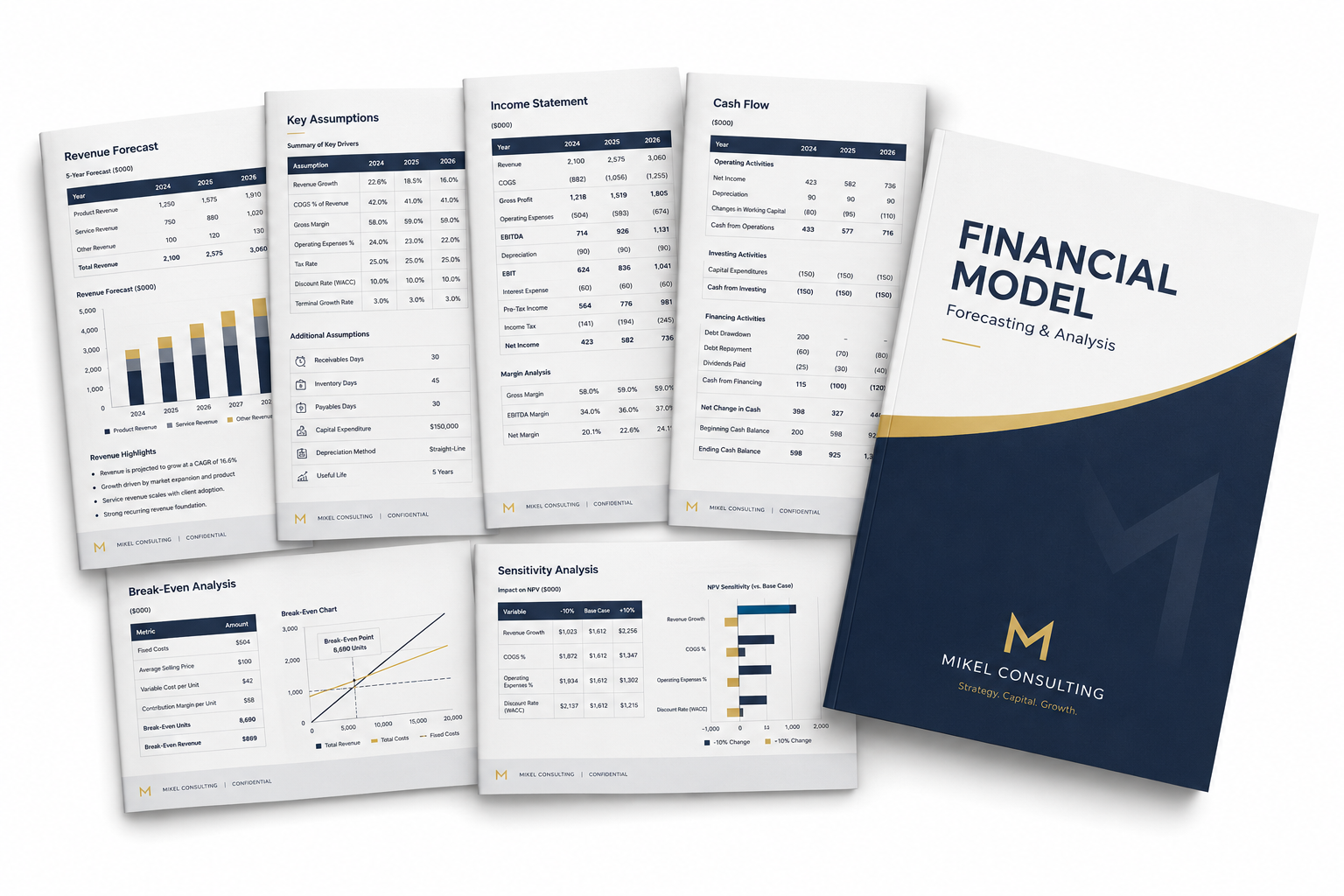
Models can include revenue drivers, operating expenses, staffing, startup costs, financing schedules, income statements, cash flow, balance sheets, break-even analysis, sensitivities, valuation support, dashboards, and visual summaries.
Our Process
How Our Financial Modeling Process Works
Modeling Objectives
We confirm the model's purpose, intended users, required outputs, forecast period, and timeline.
Engagement
You receive a contract, make payment, and provide the available financial and operating information.
Inputs & Assumptions
We review historical results, revenue drivers, costs, staffing, financing, and key assumptions.
Model Built
We build the integrated forecast, supporting schedules, cash flow, balance sheet, and scenario logic.
Scenario Review
We review the model with you and refine assumptions, scenarios, outputs, and presentation.
Final Model Delivery
You receive an editable Excel model and supporting outputs ready for planning, lenders, or investors.
Why Mikel Consulting
Why Work With Mikel Consulting for Your Financial Model?
We build clear, assumption-driven financial models that connect revenue, costs, staffing, financing, cash flow, and business decisions into one practical forecasting tool for management, lenders, and investors.
Driver-Based Forecasting
We build the forecast around the operating drivers that actually shape performance, including customers, pricing, volume, capacity, staffing, and unit economics.
Integrated Financial Statements
Where appropriate, we connect the income statement, cash flow statement, balance sheet, supporting schedules, and financing assumptions into one model.
Scenarios and Sensitivities
We can incorporate base, upside, downside, or custom scenarios so management can understand how key assumptions affect cash flow and financial performance.
Clear, Editable Model
You receive a professionally structured model with understandable assumptions, formulas, outputs, and charts that can be updated as the business evolves.
Sample Financial Models
See What Professional Financial Modeling Consulting Examples Can Look Like
Excel Model Sample
SaaS Financial Model
Review a SaaS financial model built around recurring revenue, churn, ARPU, CAC, LTV, customer growth, operating expenses, and investor-ready financial projections.
Excel Model Sample
Wholesale Financial Model
Explore a wholesale financial model with revenue assumptions, COGS, bulk discount logic, inventory planning, gross margins, and cash flow projections.
More Examples
Browse Our Sample Library
View additional sample documents, including financial models, investor business plans, pitch decks, bank loan plans, and other funding-related examples.
Financial Modeling Support
Let’s Discuss Your Financial Model
Complete the form with the model’s purpose, required outputs, forecast period, available financial information, and deadline. One of our senior consultants will review your inquiry within 24 hours. For urgent modeling projects, call or message us directly.
🔒 Your information is strictly confidential. We do not share your details with third parties.
Financial Modeling FAQ
Frequently Asked Questions About Financial Models
Detailed answers about custom financial forecasts, integrated statements, operating assumptions, scenarios, cash flow, lender and investor models, required inputs, and editable Excel delivery.
What is a financial model, and how is it used?
A financial model is a structured forecast translating business assumptions into projected financial results. It connects operating drivers—such as customers, prices, sales volume, capacity, staffing, margins, capital expenditures, and financing—to revenue, expenses, cash flow, profitability, and the balance sheet. Management can then use the model to test whether the strategy is financially workable.
Financial models support business planning, budgeting, fundraising, bank financing, acquisitions, expansion decisions, valuation discussions, cash-flow management, and scenario analysis. A useful model should not be a collection of disconnected estimates; its assumptions and formulas should show how business decisions affect future financial performance.
What can be included in a custom financial model?
Depending on the project, a model can include detailed assumptions, revenue schedules, direct-cost calculations, staffing plans, operating expenses, capital expenditures, depreciation, debt and interest schedules, equity financing, taxes, working capital, inventory, accounts receivable, accounts payable, income statements, cash flow statements, balance sheets, break-even analysis, dashboards, and key performance indicators.
The model should reflect how the specific business operates. A subscription company may require monthly recurring revenue, churn, customer acquisition, and cohort assumptions. A restaurant may require seats, traffic, average check, food cost, and labor scheduling. A multi-location business may require location-by-location ramp-up and capital planning.
Do I need an integrated three-statement model?
Not every decision requires a fully integrated income statement, cash flow statement, and balance sheet, but an integrated model is valuable when financing, working capital, capital expenditures, debt repayment, inventory, receivables, or balance-sheet changes materially affect cash. It helps ensure that profit is not confused with cash availability and that financing requirements are captured correctly.
For simpler projects, a focused operating forecast or cash-flow model may be more efficient. We recommend the structure based on the intended use, users, business complexity, available data, and required outputs rather than adding unnecessary schedules that make the model harder to maintain.
Can you build a model for a startup with no historical financial statements?
Yes. A startup model begins with operating assumptions instead of historical trends. We work from pricing, customer demand, sales capacity, launch timing, staffing, supplier costs, facilities, marketing, product development, capital expenditures, financing, and working-capital needs. The model should clearly identify which assumptions are management estimates and how they translate into monthly and annual results.
For pre-revenue companies, cash runway and milestone planning are often more important than early accounting profit. We therefore examine the timing of expenditures, hiring, customer acquisition, funding tranches, and revenue ramp-up so management can understand when additional capital may be required.
What information is needed to build the model?
We typically request historical financial statements where available, current year-to-date results, pricing, sales data, customer or unit volumes, cost of sales, payroll, contractor costs, operating expenses, capital expenditures, financing terms, taxes, working-capital assumptions, and management's growth plan. Contracts, pipeline data, quotes, staffing plans, debt schedules, and existing budgets can also be useful.
If some inputs are not yet known, we can help develop transparent assumptions using management estimates and relevant benchmarks. The goal is not to create false precision; it is to build a logical model that can be updated when better information becomes available.
How do you make revenue projections realistic?
Revenue should be built from the operating drivers management can explain and monitor. Depending on the business, these may include customers, contracts, locations, transactions, occupancy, utilization, pricing, product mix, sales representatives, conversion rates, churn, seasonality, production capacity, or project delivery capacity. We avoid relying only on a top-down percentage increase when a more practical driver-based approach is available.
We also compare the forecast with staffing, marketing, inventory, capital, and operational capacity. A model is more credible when the resources required to produce the projected sales are included and when the growth rate reflects the actual time needed to acquire customers, hire people, build capacity, or open locations.
Can the model include scenarios and sensitivity analysis?
Yes. Scenario analysis can compare a base case with downside, upside, or custom operating cases. Sensitivity analysis can show how selected variables—such as price, volume, gross margin, payroll, customer acquisition cost, churn, project timing, or interest rates—affect cash flow, profitability, valuation inputs, or financing requirements.
The most useful scenarios are tied to decisions management may actually face. Rather than changing every assumption at once, we identify the variables that matter most and structure the model so users can understand the effect of delayed sales, higher costs, slower hiring, additional capital, or alternative financing terms.
Can one financial model support lenders, investors, and internal planning?
A well-built core model can support multiple audiences, but the outputs may need to be presented differently. Lenders typically focus on cash flow, debt service, downside protection, owner contribution, collateral-related assumptions, and repayment capacity. Investors may focus more on growth, unit economics, scalability, burn, runway, capital needs, and long-term value creation. Management often needs budgets, monthly variance analysis, cash planning, and operational KPIs.
We can build one consistent forecasting engine and organize separate summaries or dashboards for the intended users. This reduces the risk that management presents conflicting numbers across the business plan, pitch deck, financing application, and internal budget.
Will the financial model be editable, and how long does development take?
Models are generally delivered in an editable Excel format with clearly organized inputs, calculations, and outputs. We aim to make the logic understandable to the intended user rather than locking the model into a black box. Final structure, formatting, protection settings, and supporting charts depend on the scope and complexity.
Turnaround varies considerably. A focused startup forecast may be completed quickly, while an integrated multi-entity, subscription, acquisition, or multi-location model requires more development and review. We confirm the scope, required schedules, forecast period, scenarios, and delivery timeline before beginning.
Are financial forecasts guaranteed to be accurate?
No forecast can guarantee future results. A financial model is a decision-support tool based on assumptions, available information, and management's strategy at a particular point in time. Actual performance can differ because of customer demand, pricing, competition, costs, hiring, financing, regulation, execution, economic conditions, and many other factors.
Our responsibility is to create a mathematically consistent, transparent, and commercially reasonable model based on the agreed inputs. Management remains responsible for reviewing and approving assumptions, updating the model as conditions change, and obtaining accounting, tax, valuation, audit, or legal advice where required.