

U.S. Laundromat Business Planning
Laundromat Business Plan Services
Custom plans for self-service laundromats, wash-and-fold operations, pickup and delivery businesses, franchises, and acquisitions.
We prepare laundromat business plans for SBA loans, equipment financing, commercial leases, investors, acquisitions, renovations, and multi-location growth. Each plan connects machine capacity, service revenue, utilities, location demand, startup costs, funding requirements, and projected cash flow.
A Plan Built Around Location, Equipment, Utilities, and Cash Flow
Can Include:
- Self-service, wash-and-fold, pickup, and delivery revenue
- Machine mix, capacity, utilities, staffing, and workflow
- Location demand, demographics, and nearby competition
- Equipment costs, use of funds, and five-year projections
Laundromat Business Plan Overview
Business Plans That Connect Location, Equipment, Utilization, and Cash Flow
A laundromat business plan explains how the store’s location, customer base, machine mix, vend pricing, utilities, service offerings, staffing, maintenance, equipment financing, and operating model produce sustainable cash flow. It gives lenders, investors, landlords, and sellers a structured view of the startup, acquisition, renovation, or expansion.
Mikel Consulting Track Record
Supporting laundromat owners preparing to start, acquire, renovate, and expand stores
Laundry Businesses Supported
Laundry Businesses We Support
Laundromat and Laundry Service Business Types We Support
Coin-Operated Laundromats
A coin laundromat business plan covering machine mix, vend prices, turns per day, collections, utilities, maintenance, location demand, equipment financing, and store operations.
Card & App-Based Laundromats
A modern laundromat business plan for card, mobile-payment, loyalty, remote-management, and cashless stores using connected equipment and customer-retention technology.
Wash-and-Fold Businesses
A wash-and-fold business plan built around pounds processed, price per pound, staffing, workflow, packaging, equipment capacity, customer frequency, and service margins.
Pickup & Delivery Laundry
A laundry delivery business plan covering online ordering, routes, drivers, vehicles, minimum orders, delivery software, processing capacity, marketing, and recurring customers.
Commercial Laundry Services
A commercial laundry business plan for hospitality, healthcare, restaurants, salons, gyms, short-term rentals, uniforms, linens, recurring contracts, and high-volume processing.
Eco-Friendly Laundromats
An environmentally focused laundromat business plan for efficient machines, water and energy conservation, sustainable detergents, modern store design, and green positioning.
Laundromat Acquisitions
A laundromat acquisition business plan incorporating historical collections, utility bills, machine age, lease terms, service revenue, repairs, purchase price, and planned improvements.
Multi-Location Laundry Companies
A laundromat expansion plan for operators adding stores, centralizing wash-and-fold, building delivery routes, standardizing management, and financing additional equipment.
Business Plan Content
What Your Laundromat Business Plan Includes
Each plan is customized to your location, machine mix, funding purpose and operating strategy.
Market & Competitive Analysis
Renter density, household characteristics and neighborhood demand, together with an assessment of nearby laundromats and apartment facilities.
Business Model & Services
Self-service laundry, wash-and-fold, pickup and delivery, vending and commercial accounts, including pricing and machine mix.
Store Operations
Operating hours, payment systems, cleaning, equipment maintenance, security, utilities and customer support.
Marketing Strategy
Local search, apartment partnerships, loyalty programs, delivery promotion, signage and neighborhood outreach.
Management & Staffing
Owner oversight, attendants, wash-and-fold staff, delivery drivers and maintenance support.
Financial Plan & Implementation
Turns per day, machine utilization, utilities, labor, maintenance, equipment financing and opening milestones.
Sample Laundromat Plan Preview
Professional, Decision-Ready Formatting
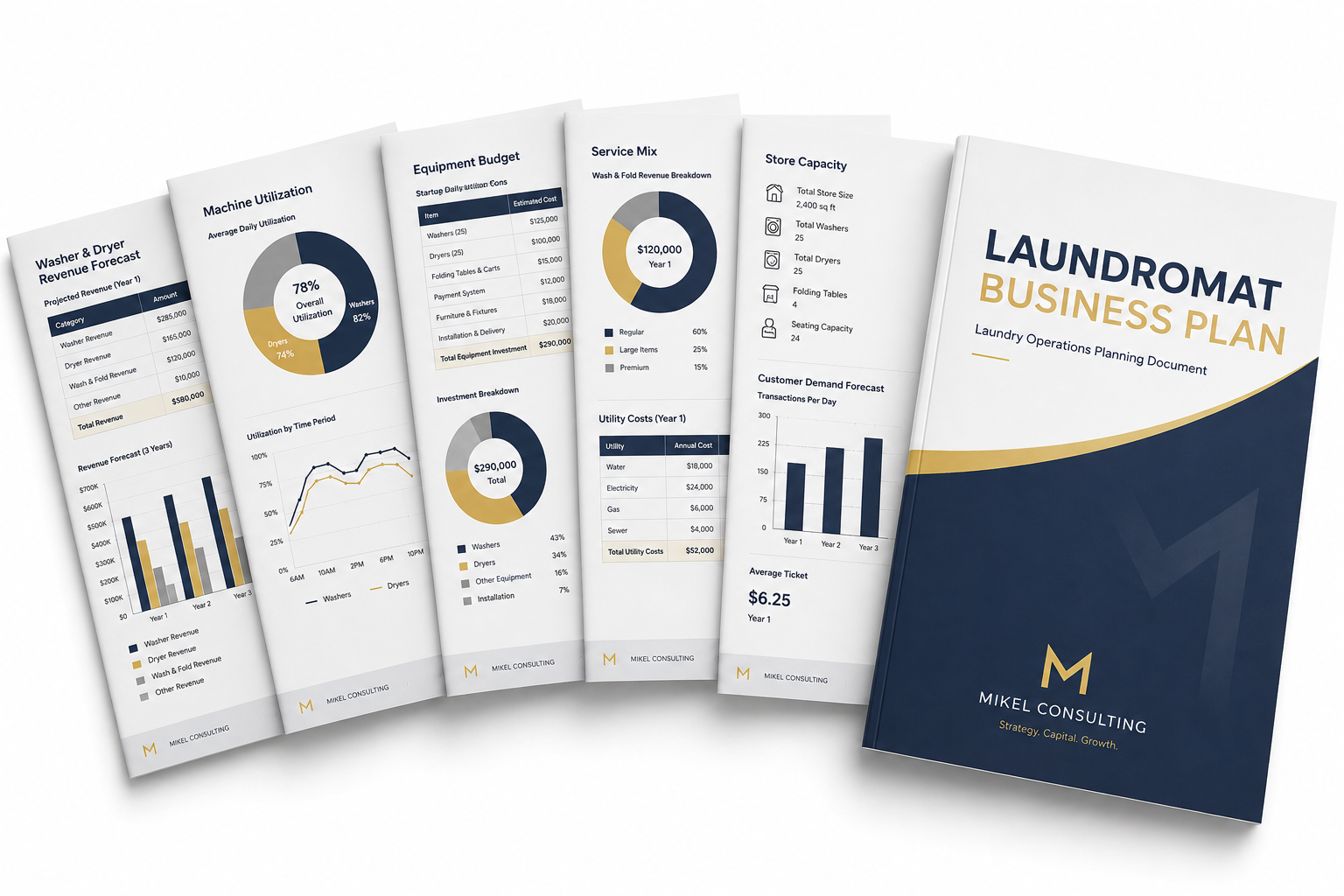
Your laundromat business plan turns location, machine capacity and customer usage into an evidence-based operating and financial strategy.
Funding and Planning Uses
Laundromat Business Plans for SBA Loans and Acquisitions
A laundromat business plan can support an SBA loan, equipment financing, an acquisition, investor discussions, immigration planning or the development of a new self-service laundry location.
Bank Loan Business Plans
Support financing for washers, dryers, payment systems, renovations, utility infrastructure, working capital or a laundromat acquisition.
Explore Bank Loan Plans For SBA FinancingSBA Loan Business Plans
Prepare an SBA 7(a) or 504 business plan for a laundromat startup, acquisition, equipment purchase, renovation or owner-occupied property.
Explore SBA Loan Plans For Equity CapitalInvestor Business Plans
Present the location strategy, equipment configuration, unattended or staffed model, additional services and opportunity for multi-location growth.
Explore Investor Plans For Visa ApplicationsImmigration Business Plans
Document the investment, equipment purchases, operating model, owner’s management role, staffing and expected development of a U.S. laundromat.
Explore Immigration Plans For ForecastingFinancial Modeling
Forecast machine turns, capacity, vend prices, wash-and-fold sales, utilities, labor, lease costs, maintenance and store-level cash flow.
Explore Financial Models For Location DecisionsFeasibility Studies
Evaluate renter density, household demographics, competition, parking, utility capacity, equipment needs, pricing and projected financial performance.
Explore Feasibility StudiesLaundromat Business Plan Guide
How to Write a Laundromat Business Plan for Financing and Profitability
A strong laundromat business plan should connect neighborhood demand, machine capacity, customer usage, utility expenses and equipment financing in one location-specific strategy.
Define the Laundromat Business Model
Explain whether the business will offer self-service laundry, wash-and-fold, pickup and delivery, commercial accounts or vending. Identify the target neighborhood and proposed operating hours.
Research the Location and Competition
Analyze renter density, household characteristics, population, traffic, parking and nearby apartments. Compare competitors based on machine quality, pricing, cleanliness, services and reviews.
Determine the Machine Mix and Pricing
Identify the number and size of washers and dryers, expected turns per day and customer pricing. Include revenue from wash-and-fold, delivery, vending and commercial accounts where applicable.
Develop the Store Operating Plan
Explain payment systems, cleaning, staffing, security, equipment maintenance and customer service. Estimate water, electricity, gas, sewer and other location-specific operating costs.
Calculate Equipment and Funding Needs
Identify costs for machines, water systems, leasehold improvements, payment technology, signage and working capital. Explain owner equity, vendor financing and requested bank or SBA financing.
Prepare Utilization-Based Projections
Forecast revenue from machine counts, turns per day and pricing. Include utilities, rent, maintenance, labor, debt service, cash flow and break-even performance.
Our Process
How Our Laundromat Business Plan Process Works
Discovery
We review your location, machine mix, services, funding purpose and development timeline.
Engagement
You receive a contract, make payment and complete our structured intake questionnaire.
Information Review
We review your site, lease, equipment, pricing, utility costs and staffing assumptions.
Research & Financials
We assess local demand and competitors and model turns per day, utilities and cash flow.
Draft & Revisions
You review the draft and we refine the plan for accuracy, clarity and funding readiness.
Final Delivery
You receive polished PDF and editable files ready for your intended audience.
Why Mikel Consulting
Why Work With Mikel Consulting for Your Laundromat Business Plan?
We combine location research, operating strategy and machine-level financial forecasting into a professional plan built around your store, services and financing requirements.
Local Market Research
We assess renter density, household characteristics, traffic, neighborhood demand and competing laundromats.
Location-Specific Strategy
We present your site, machine mix, pricing, payment systems, service offerings, staffing and maintenance approach.
Integrated Financial Projections
Our forecasts connect turns per day, machine pricing, utility costs, ancillary services, maintenance, labor and cash flow.
Senior Consultant Involvement
Your plan is developed and reviewed by experienced consultants who understand equipment financing and location-based businesses.
Laundromat Business Plan Examples
Explore Bank Loan and Investor Business Plan Examples
These general examples demonstrate the location analysis, funding presentation, operating strategy and financial forecasts we adapt for a laundromat business plan.
Bank Loan Business Plan Example
Restaurant Bank Loan Plan
Review how an equipment- and location-dependent business presents startup costs, use of funds, operations and repayment-focused projections.
Investor Business Plan Example
Environmental Consulting
See how a growth-stage company presents its market opportunity, operating model, expansion strategy, funding request and financial potential.
More Business Plan Examples
Browse Our Sample Library
Explore additional business plans, financial models, feasibility studies and other professional planning documents.
Laundromat Business Plan Support
Let’s Discuss Your Laundromat Business Plan
Complete the form with your proposed or existing location, machine and service mix, startup or acquisition plans, equipment needs, financing request, and deadline. One of our senior consultants will review your inquiry within 24 hours. For a time-sensitive loan, lease, or purchase opportunity, call or message us directly.
🔒 Your information is strictly confidential. We do not share your details with third parties.
Laundromat Business Plan FAQ
Frequently Asked Questions About Laundromat Business Plans
What should a laundromat business plan include?
A laundromat business plan should explain the location, trade area, customer profile, machine mix, vend pricing, operating hours, utilities, staffing, security, cleaning, maintenance, payment system, marketing, and growth strategy. It should identify whether the business offers self-service laundry, wash-and-fold, commercial accounts, pickup and delivery, dry-cleaning drop-off, vending, or related services.
The financial section should connect machine turns, pounds processed, service orders, pricing, capacity, utility consumption, labor, rent, equipment debt, maintenance, and cash flow.
Can the plan support SBA loans or laundromat equipment financing?
Yes. The plan can support SBA-backed or conventional loans, equipment financing, lease approval, acquisitions, renovations, and expansion. Uses of funds may include washers, dryers, payment systems, water heating, plumbing, electrical work, ventilation, leasehold improvements, furniture, signage, vehicles, deposits, inventory, and working capital.
Equipment quotes and contractor estimates help establish a reliable project budget. The plan should also show how the proposed machine mix and service revenue can support rent, utilities, payroll, maintenance, and debt service.
How should self-service laundry revenue be forecast?
Self-service revenue can be modeled by washer and dryer type, machine count, vend price, turns per day, operating days, and ramp-up. Washer and dryer revenue should be internally consistent, and assumptions should reflect the local customer base, competing stores, equipment size, pricing, store quality, and seasonality.
The model should use practical average utilization rather than assuming every machine runs continuously. It should also consider downtime, promotional pricing, refunds, payment-processing fees, and the effect of larger-capacity machines.
How are wash-and-fold and pickup-and-delivery services modeled?
Wash-and-fold revenue is generally built from pounds processed, price per pound, order frequency, and production capacity. Pickup and delivery adds route density, driver time, vehicles, fuel, delivery software, minimum orders, and customer-acquisition costs. Commercial accounts may have different pricing and payment terms.
The plan should separate these services from unattended self-service revenue because they require more labor, workflow management, quality control, packaging, and working capital.
Why are utilities so important in a laundromat plan?
Water, sewer, natural gas, and electricity can materially affect profitability. Utility assumptions should reflect machine efficiency, local rates, hot-water systems, store hours, turns, and any lease provisions. Historical utility bills are particularly valuable when evaluating an existing location.
A plan should not simply apply a generic utility percentage if equipment specifications, bills, or local rates are available. It should also allow for rate increases and equipment maintenance.
What location research belongs in the plan?
The analysis can examine renter concentration, household size, income, housing type, in-unit laundry access, population density, traffic, parking, visibility, nearby apartments, competing laundromats, machine quality, pricing, reviews, and the practical customer trade area. Physical utility capacity and lease terms are as important as demographic demand.
For an acquisition, the plan should also examine historical turns, collections, service revenue, repair records, utility bills, equipment age, store condition, and the transferability of the lease.
What are common weaknesses in a laundromat business plan?
Common weaknesses include overestimating turns per day, understating utilities, ignoring machine downtime and repairs, selecting a weak site, failing to verify utility capacity, and omitting sufficient renovation and working capital. Acquisition plans may rely on seller claims without reconciling collections, tax returns, utility bills, and equipment condition.
A credible plan connects the trade area, machine mix, utilization, service revenue, utilities, rent, equipment financing, and owner oversight.
What information does Mikel Consulting need to prepare a laundromat business plan?
We typically request information about your location, lease or property terms, machine count and capacity, equipment quotes, vend pricing, utility assumptions, operating hours, wash-and-fold or pickup-and-delivery services, staffing, competitors, customer demographics, renovation costs, owner contribution, financing request, and any historical store data. The exact list depends on whether the project involves a startup, acquisition, expansion, financing request, investor presentation, licensing process, or internal planning.
Not every decision must be final before work begins. Our intake process helps identify gaps, and reasonable assumptions can be developed where information is still being confirmed. The client remains responsible for verifying ownership, legal, regulatory, transaction, and financial information before the plan is submitted or relied upon.
How long does a laundromat business plan take, and what does it cost?
Our U.S. laundromat business plans currently start at $1,000 USD. A typical first draft is delivered within 7 to 10 business days after we receive the required information. More complex developments, acquisitions, multi-location operations, specialized research, extensive financial cleanup, or urgent deadlines may require a custom scope, price, and schedule.
The service includes research, written strategy, financial projections, professional formatting, and revision support for 30 days after the first draft. Final delivery can include a polished PDF and editable working files.
Can a professionally prepared laundromat business plan guarantee financing or approval?
No. A professional plan can improve how the business, market opportunity, operating strategy, funding requirement, and financial projections are presented, but it cannot guarantee a decision by a lender, investor, landlord, equipment-financing provider, seller, or other reviewer. Outcomes depend on the complete application, applicant qualifications, credit and financial position, available capital, collateral where relevant, regulatory eligibility, market conditions, and the reviewer’s independent criteria.
Mikel Consulting’s role is to develop a credible, internally consistent plan, identify unsupported assumptions, and communicate the business case clearly. The relevant lender, investor, agency, landlord, or other decision-maker remains solely responsible for its review and decision.