

U.S. Treaty Investor Visa Support
E-2 Visa Business Plans
Build Your Business in the United States
Turn your U.S. investment plans into a comprehensive E-2 business plan built around the requirements of the Treaty Investor visa. Whether you are launching a new venture, purchasing an existing business, or investing in a franchise, our plans present your investment, ownership, operating strategy, financial projections, and the enterprise’s capacity for sustainable U.S. growth.
E-2 Visa Business Plan Package
Includes:
- E-2-focused treaty investor business plan
- U.S. market, industry, and location analysis
- Investment, ownership, and operating strategy
- Financial forecast, hiring plan, and growth roadmap
E-2 Business Plan Overview
Business Plans Built Around the E-2 Treaty Investor Visa
An E-2 business plan helps present how a qualifying investment will be used to establish, acquire, or grow a real and operating U.S. enterprise. It brings together the investment, business model, ownership structure, market opportunity, operating strategy, financial projections, and future growth of the company in one clear and credible document.
For E-2 applicants, the plan should also demonstrate how the enterprise is positioned to operate sustainably and develop beyond simply providing a minimal living for the investor and their family. This makes realistic revenue projections, hiring plans, market analysis, and a well-supported growth strategy particularly important.
Mikel Consulting Record of Success
Trusted by entrepreneurs, immigration professionals, and clients across 90+ countries
E-2 Visa Program Snapshot
Understanding the E-2 Treaty Investor Visa
What the E-2 visa is designed for
The E-2 Treaty Investor visa allows qualifying nationals of treaty countries to enter the United States to develop and direct a U.S. business in which they have invested, or are actively in the process of investing, a substantial amount of capital.
The investment must be committed to a real and operating commercial enterprise, and the business must be positioned to generate more than simply a minimal living for the investor and their family or otherwise make a significant economic contribution in the United States.
The principal investor must be a national of a country that maintains a qualifying E-2 treaty relationship with the United States.
The investor must make a substantial investment relative to the cost and nature of the enterprise. There is no universal fixed minimum investment amount.
The investment must be placed in a real, active, and operating commercial enterprise rather than a passive or speculative investment.
The principal E-2 investor must come to the United States to develop and direct the enterprise, generally through qualifying ownership or operational control.
The business must have the present or future capacity to generate more than a minimal living for the investor and family, or otherwise make a significant economic contribution.
E-2 Business Plan Requirements
What a Strong E-2 Business Plan Should Demonstrate
An E-2 business plan should clearly show how the investor’s committed capital will support a real and operating U.S. enterprise, how the business will be developed and directed, and how it is positioned for sustainable commercial growth.
The plan should present a credible connection between the investment, business model, operating strategy, market opportunity, financial performance, and future economic activity of the U.S. enterprise.
Investment Strategy
Clear explanation of the capital invested or committed, startup or acquisition costs, and how funds will be deployed throughout the business.
Ownership & Control
A clear picture of the investor’s ownership position, management responsibilities, and ability to develop and direct the enterprise.
Real & Operating Enterprise
A practical operating model showing how the company will deliver its products or services, generate revenue, and conduct active commercial operations.
U.S. Market Opportunity
Evidence-based analysis of customers, competitors, industry conditions, pricing, location, and the market opportunity supporting the business.
Growth & Non-Marginality
A credible growth strategy demonstrating the enterprise’s capacity to develop beyond merely providing a minimal living for the investor and family.
Financial Forecast
Detailed revenue, expense, cash flow, profitability, staffing, and growth projections supported by realistic operating assumptions.
Service Details
E-2 Visa Business Plan Delivery Details
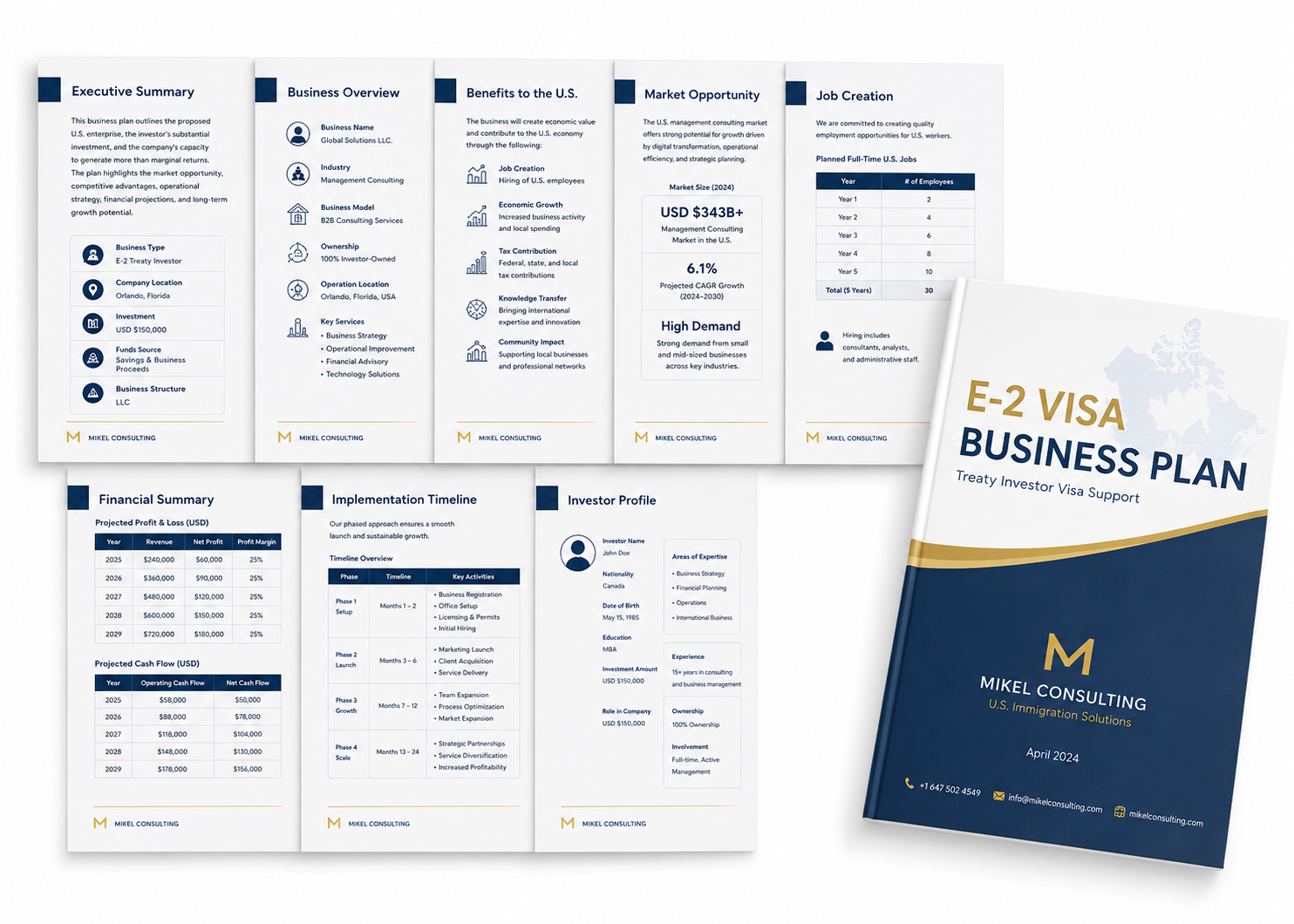
Sample Document Preview
Professional, E-2-Focused Formatting
E-2 business plans can include the investment structure, company overview, U.S. market opportunity, products and services, operating strategy, competitive analysis, staffing plan, five-year financial projections, and a clear roadmap for establishing, acquiring, or growing the U.S. enterprise.
Our Process
How Our E2-Visa Business Plan Process Works
Intro Call or Email
We discuss your business concept, applicant background, timeline, and C11 planning needs.
Engagement Process
We confirm the scope, complete onboarding, and provide a structured information request.
Information Review
Our team reviews your business details, applicant profile, documents, and financial assumptions.
Plan Development
We prepare the business plan, market research, operating strategy, and financial forecast.
Review & Revisions
You review the draft and we refine the plan for clarity, accuracy, and application alignment.
Final Delivery
The final E2-Visa business plan is delivered in polished PDF and editable formats.
Why Mikel Consulting
Why Work With Mikel Consulting for Your E-2 Visa Business Plan?
We combine immigration-focused business plan writing, financial projections, U.S. market research, and E-2-specific positioning into one clear, professional document.
Immigration-Focused Business Plans
We structure the plan around the investor, business model, investment strategy, U.S. operations, staffing plan, growth potential, and financial forecast.
Experience With Investor Applications
We know how to present startups, business acquisitions, franchises, and operating companies in a clear and credible manner for E-2-focused applications.
Attorney-Friendly Drafting Process
We can work alongside your U.S. immigration attorney and revise the business plan based on legal feedback, filing strategy, and application requirements.
Financial and U.S. Market Research Support
We combine market research, operating assumptions, staffing plans, investment details, and financial projections into one cohesive document.
Sample E-2 Business Plans
E-2 Visa Business Plan Examples for U.S. Treaty Investors
E-2 Visa Sample
Karate Studio
An E-2 business plan for a martial arts and education business, presenting the investor’s ownership and management role, U.S. operations, market opportunity, staffing strategy, financial projections, and long-term growth plan.
View Plan →E-2 Visa Sample
Sustainable Biofertilizer
An E-2 business plan for an innovative biotechnology and sustainable agriculture venture, presenting the investment, U.S. market opportunity, operating model, job creation strategy, financial outlook, and potential for commercial growth.
View Plan →More U.S. Immigration Examples
Browse Our Sample Library
Explore additional business plan examples prepared for U.S. investor, business expansion, and employment-based immigration programs.
Browse U.S. Examples →E-2 Business Plan Support
Let’s Build Your E-2 Visa Business Plan
Complete the form and one of our senior consultants will review your inquiry within 24 hours. For time-sensitive E-2 visa business plan support, call or message us directly.
🔒 Your information is strictly confidential. We do not share your details with third parties.
E-2 Visa Business Plan FAQ
Frequently Asked Questions
What is the E-2 Treaty Investor Visa?
The E-2 is a temporary nonimmigrant visa available to qualifying nationals of treaty countries who invest, or are actively in the process of investing, a substantial amount of capital in a U.S. enterprise. The principal investor must generally come to the United States to develop and direct the business. The enterprise must be real and operating, and the investment must be committed to the business rather than simply held as uncommitted funds.
Who is eligible to apply for an E-2 visa?
The principal investor must be a national of a country that maintains a qualifying E-2 treaty relationship with the United States. The U.S. enterprise must also have qualifying treaty nationality, which generally means that at least 50% of the business is owned by nationals of the applicable treaty country. The investor must have made, or be actively making, a substantial investment and must be positioned to develop and direct the enterprise.
How much do I need to invest for an E-2 visa?
There is no universal minimum dollar amount that applies to every E-2 investment. Instead, the investment must be substantial in relation to the total cost of purchasing or establishing the particular business. A lower-cost service business may therefore require a different investment level than a restaurant, franchise, manufacturing operation, or capital-intensive company. The amount should also demonstrate the investor's financial commitment to the success of the enterprise.
What does it mean for the E-2 investment to be “at risk” or committed?
E-2 capital should be genuinely committed to the enterprise and subject to commercial risk. Simply transferring money into a personal or business bank account without committing it to the investment is generally not enough. Depending on the transaction, evidence may include business purchases, equipment, inventory, lease costs, deposits, professional fees, operating expenditures, funds held under a qualifying escrow arrangement, or amounts committed toward the acquisition of an existing business.
What types of businesses can qualify for an E-2 visa?
E-2 enterprises can operate across many industries, provided the company is a real and active commercial enterprise and the investment otherwise satisfies the E-2 requirements. Applicants may establish a new company, acquire an existing business, purchase a franchise, or invest in another qualifying operating enterprise. Service businesses, restaurants, retail businesses, professional firms, technology companies, manufacturing operations, construction companies, hospitality businesses, and many other models may potentially qualify. Passive investments alone generally do not satisfy the operating-enterprise requirement.
Can I buy an existing business for an E-2 visa?
Yes. Purchasing an existing U.S. business is a common E-2 investment structure. The application should clearly document the acquisition, ownership, committed investment, business operations, financial position, and the investor's role in developing and directing the company. An acquisition-focused business plan can also explain the transition strategy, future growth, staffing, marketing, operational improvements, and financial projections under the new ownership.
Can I use a franchise for an E-2 visa?
Yes. A franchise can potentially qualify for E-2 purposes in the same way as other qualifying operating businesses. The investment must still be substantial relative to the enterprise, properly committed, and placed into a real and operating U.S. business. The investor must also meet the applicable ownership and develop-and-direct requirements. A business plan should reflect the specific franchise model, local market, startup costs, staffing, operating assumptions, and projected financial performance.
What does “develop and direct” mean for an E-2 investor?
The principal investor must demonstrate the ability to develop and direct the U.S. enterprise. This is commonly established through ownership of at least 50% of the business or through other evidence of operational control. The business plan should therefore clearly explain the investor's ownership position, management responsibilities, decision-making authority, and ongoing role in the company's operations and growth.
What is a marginal business under the E-2 visa?
A marginal enterprise is generally one that lacks the present or future capacity to generate more than enough income to provide a minimal living for the investor and their family. An enterprise may also satisfy the standard by demonstrating the capacity to make a significant economic contribution in the United States. This is why credible growth projections, staffing, revenue development, operating plans, and market evidence are important components of many E-2 business plans.
Does an E-2 business have to create U.S. jobs?
There is no fixed statutory E-2 requirement to create a specific number of U.S. jobs. However, planned employment can be important evidence that the enterprise is positioned to grow beyond a marginal business and contribute economically in the United States. The appropriate hiring plan depends on the business model, size, location, operating requirements, and expected growth. Staffing projections should therefore be realistic and supported by the company's financial forecast and operating strategy.
What should an E-2 visa business plan include?
A strong E-2 business plan typically explains the company, ownership structure, investor background, investment and use of funds, products or services, U.S. market opportunity, competitive landscape, marketing strategy, operating plan, management structure, staffing, implementation timeline, and detailed financial projections. The plan should also clearly connect these elements to the enterprise's commercial viability, growth potential, and the investor's role in developing and directing the business.
Is a business plan legally required for every E-2 visa application?
U.S. immigration rules do not prescribe one universal business-plan format for every E-2 application. However, applicants must provide sufficient evidence to establish that the investment enterprise satisfies the applicable E-2 requirements. For new businesses, recently acquired companies, and enterprises relying on future growth to demonstrate non-marginality, a detailed business plan can be particularly useful in presenting the investment, operations, market opportunity, staffing, and financial outlook in a clear and organized manner.
What supporting documents are commonly used in an E-2 application?
Documentation varies by applicant, investment structure, business, and consular post. Common evidence may include corporate formation documents, ownership records, purchase agreements, franchise agreements, leases, bank and wire records, invoices, equipment or inventory purchases, proof of source and movement of funds, contracts, licenses, operating records, financial statements, tax documents, and a detailed business plan. Applicants should follow the instructions of the U.S. embassy, consulate, USCIS, and their immigration attorney for their specific filing.
How long is an E-2 visa valid and can it be renewed?
E-2 visa validity is based in part on the reciprocity rules applicable to the applicant's nationality and should not be confused with the period of authorized stay after admission to the United States. E-2 investors are generally admitted for periods of up to two years, and qualifying extensions of stay may be granted in increments of up to two years. E-2 visas may also be renewed where the investor and enterprise continue to satisfy the applicable requirements. There is no single lifetime limit that applies to every qualifying E-2 investor.
Does the E-2 visa lead directly to a Green Card?
No. The E-2 is a nonimmigrant visa and does not itself provide permanent residence or an automatic path to a Green Card. Some E-2 investors may later qualify for a separate immigrant category based on employment, investment, family, or another available pathway, but that is a separate immigration process with its own requirements. E-2 applicants should obtain advice from a qualified U.S. immigration attorney regarding any long-term permanent residence strategy.
Can my spouse and children come with me on an E-2 visa?
A qualifying spouse and unmarried children under the age of 21 may generally apply for derivative E status to accompany or join the principal E-2 investor. The dependents do not necessarily need to hold the same treaty-country nationality as the principal investor. Qualifying E spouses may be employment authorized based on their status, while children do not receive employment authorization merely from dependent E status. Family members may also attend school while maintaining valid status.
Is the E-2 visa the same as the EB-5 investor program?
No. The E-2 and EB-5 are different immigration classifications. The E-2 is a temporary treaty-based nonimmigrant visa and does not have one universal minimum investment or a fixed requirement to create 10 jobs. EB-5 is an immigrant investor category designed to provide a pathway toward permanent residence when its separate investment, job-creation, and other requirements are satisfied. The appropriate program depends on the investor's nationality, capital, business structure, immigration goals, and broader circumstances.
Can Mikel Consulting work with my U.S. immigration attorney?
Yes. Mikel Consulting regularly works alongside immigration attorneys and law firms on business-plan engagements. We focus on the business plan, market research, financial projections, investment presentation, operating strategy, staffing plan, and supporting commercial narrative, while the attorney provides legal advice regarding eligibility, application strategy, forms, documentation, and filing requirements.
How much does an E-2 visa business plan cost?
Our E-2 visa business plans start at $1,200 USD. The service typically includes a professionally prepared business plan, U.S. market research, investment and operating strategy, staffing plan, and detailed financial projections. E-2 plans are typically 35–45 pages, include unlimited revision support, and are generally completed within 7 business days after the required business, investor, and financial information is received.
Additional Support
Related U.S. Immigration Business Plan and Legal Support
Need a U.S. Immigration Lawyer?
We can connect you with a vetted U.S. immigration lawyer experienced in investor, entrepreneur, business expansion, and employment-based applications.
Request a ReferralAre You an Immigration Lawyer?
Join our partner network and provide your clients with professionally prepared business plans, financial projections, market research, and revision support.
Join Our Partner Program