

Commercial Lease Support
Landlord Business Plans
Professional business plans that help commercial landlords evaluate your concept, financial capacity, and long-term tenancy potential.
Give landlords a clear reason to approve your lease application. We prepare customized plans that explain your business concept, ownership, target market, operating model, location requirements, financial projections, rent capacity, and growth strategy—helping position your company as a credible and well-prepared tenant.
Built for Commercial Lease and Landlord Review
Includes:
- Landlord-ready business plan
- Business concept and tenant profile
- Financial projections and rent capacity
- Location, operating, and growth strategy
Landlord Business Plan Overview
Professional Business Plans for Commercial Lease and Landlord Approval
A landlord business plan helps a property owner or leasing team evaluate the proposed tenant, business concept, ownership, target customers, operating model, financial capacity, location requirements, and ability to meet ongoing lease obligations. It should reduce uncertainty by showing that the business is credible, prepared, and positioned to operate successfully from the proposed premises.
Mikel Consulting Track Record
Supporting entrepreneurs and established businesses pursuing commercial locations
Commercial Property Audiences
Service Details
Landlord Business Plan Delivery Details
Sample Document Preview
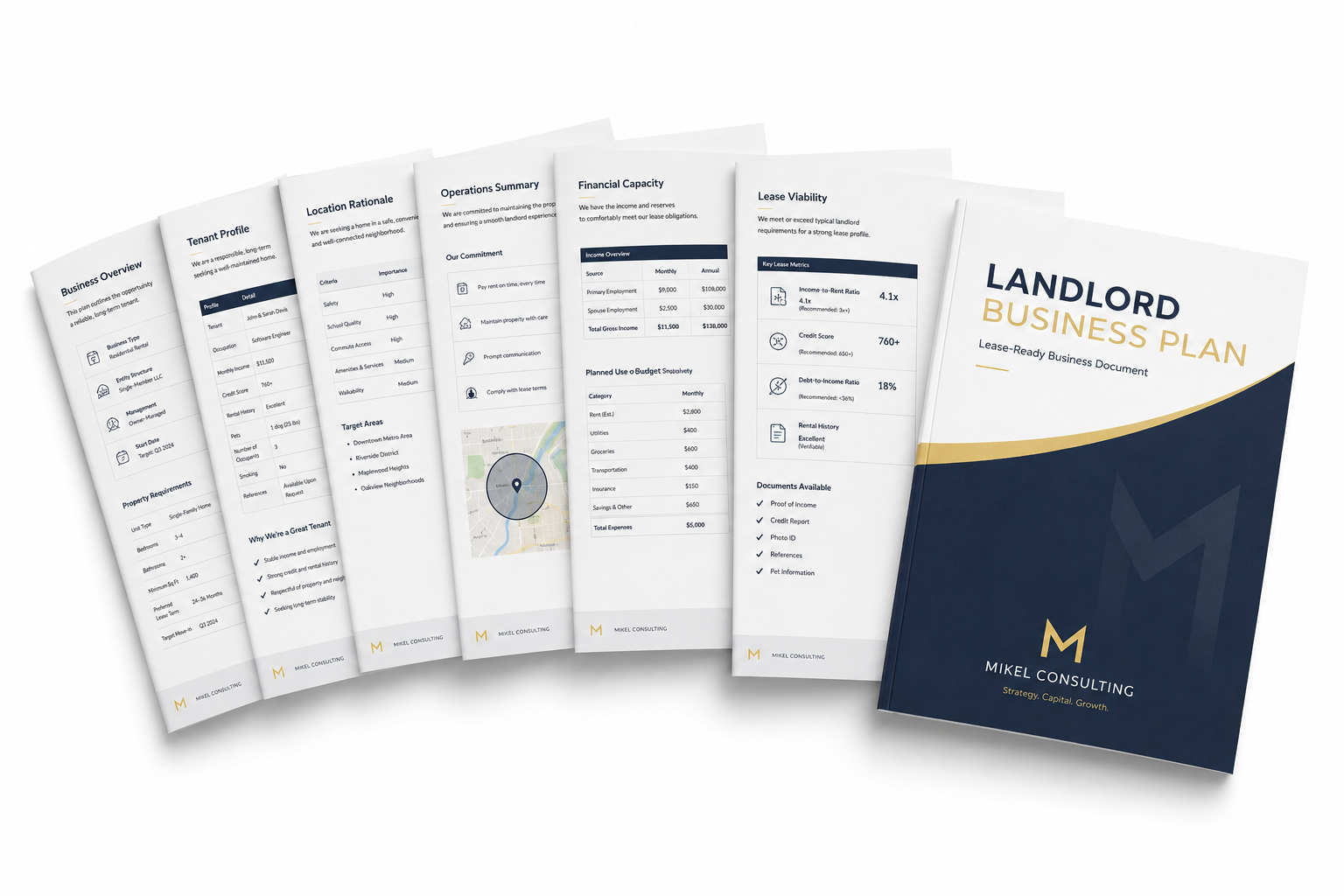
Professional, Landlord-Ready Formatting
Plans can include the tenant and ownership profile, business concept, proposed location, customer demand, operating strategy, management experience, startup costs, financial projections, rent capacity, and evidence supporting a stable commercial tenancy.
Our Process
How Our Landlord Business Plan Process Works
Property & Lease Review
We review the business concept, proposed location, lease timeline, and landlord requirements.
Engagement
You receive a contract, make payment, and complete a straightforward intake questionnaire.
Information Review
We assess the ownership, operating plan, space requirements, startup budget, and financial inputs.
Plan Drafted
We prepare the business overview, market support, operating plan, funding position, and forecast.
Review & Revisions
You review the draft and we refine it for accuracy, credibility, and landlord readiness.
Final Delivery
You receive polished PDF and editable files ready to share with the landlord or property manager.
Why Mikel Consulting
Why Work With Mikel Consulting for Your Landlord Business Plan?
We prepare clear, professional business plans that help landlords and property managers understand the concept, ownership, operating model, location strategy, financial capacity, and proposed use of the premises.
Property-Ready Structure
We organize the plan around the business concept, ownership, proposed location, space requirements, operating hours, customer activity, and lease objectives.
Credible Business Presentation
We present the company, management experience, market opportunity, launch strategy, and operating plan in a format suitable for landlord or leasing review.
Clear Premises and Funding Plan
We explain how the space will be used, required improvements, startup costs, available capital, opening timeline, and other details relevant to the proposed tenancy.
Rent-Capacity Forecasting
We build projections connecting sales, expenses, working capital, cash flow, and occupancy costs to demonstrate the business's ability to support the proposed lease.
Sample Business Plans
See What a Professional Landlord Business Plan Can Look Like
Business Plan Sample
Restaurant Concept
See how a restaurant business plan can present the concept, operating model, target customers, location fit, startup needs, and financial outlook in a clear, landlord-ready format.
Expansion Plan Sample
Pilates Studio
Review a studio expansion example showing how service offerings, local demand, leasehold needs, operating assumptions, and projected performance can be structured for a commercial lease application.
More Examples
Browse Our Sample Library
View additional sample documents, including landlord business plans, bank loan plans, investor plans, pitch decks, financial models, and other funding-related examples.
Commercial Lease Business Plan Support
Let’s Discuss Your Landlord Business Plan
Complete the form with your business concept, proposed property or location, landlord requirements, and lease timeline. One of our senior consultants will review your inquiry within 24 hours. For urgent leasing opportunities, call or message us directly.
🔒 Your information is strictly confidential. We do not share your details with third parties.
Landlord Business Plan FAQ
Frequently Asked Questions About Landlord Business Plans
Detailed answers about business plans for commercial lease applications, landlord review, proposed premises, operating requirements, startup costs, rent capacity, required information, and important limitations.
What is a landlord business plan?
A landlord business plan is a professional document prepared to help a commercial landlord, leasing representative, or property manager evaluate a prospective tenant. It explains the business concept, ownership, management experience, products or services, target customers, market opportunity, operating model, proposed use of the premises, startup or expansion plan, funding position, and financial outlook.
The plan is especially useful when the tenant is a startup, opening a new location, entering a new market, or proposing a specialized use. It gives the landlord context that may not be visible from a credit application or financial statement alone.
Why would a commercial landlord request a business plan?
A commercial lease creates a long-term financial and property relationship. The landlord may want to understand whether the business is credible, adequately funded, suitable for the property, capable of opening on schedule, and likely to pay rent throughout the term. The plan can also explain customer activity, operating hours, staffing, equipment, improvements, licenses, noise, odors, deliveries, utilities, parking, and other factors affecting the premises.
The business plan does not replace the landlord's credit checks, deposits, guarantees, references, financial statements, or lease negotiations. It supports those reviews by presenting the proposed tenancy in a clear and organized way.
What should a business plan for a lease application include?
A landlord-facing plan commonly includes the company and owners, management experience, business concept, products or services, industry and local market research, target customers, competition, marketing, operating hours, staffing, suppliers, location requirements, space use, equipment, leasehold improvements, permits, opening schedule, startup costs, funding sources, and financial projections.
The emphasis should reflect the property. A restaurant may need seating, kitchen, ventilation, deliveries, liquor licensing, and food-service assumptions. A medical or wellness use may require treatment rooms and regulatory considerations. A retail concept may focus on traffic, merchandise, inventory, signage, and seasonal sales.
How should the proposed premises and lease requirements be addressed?
The plan should explain why the location suits the target market and operating model, how the space will be used, the approximate square footage required, expected customer and employee activity, hours, parking or access needs, major equipment, utility requirements, signage, renovations, and the intended opening timeline. Known lease terms and occupancy costs should be reflected accurately in the forecast.
The plan should not make technical, zoning, permitting, construction, or code assumptions without verification. The applicant should work with the landlord, broker, architect, contractor, municipal authorities, and legal counsel to confirm whether the property and lease permit the intended use.
What financial information does a landlord usually want to see?
Landlords may review the owner's financial position, capital available, credit, business history, existing financial statements, startup budget, sources of funding, projected revenue, operating expenses, cash flow, and ability to cover rent and other occupancy costs. Requirements vary based on the property, lease term, tenant history, landlord, and amount of investment required in the space.
The business plan should show that rent, common-area charges, utilities, insurance, maintenance, property-related fees, payroll, inventory, debt service, and working capital have been considered together. For startups, sufficient opening capital and a realistic sales ramp are particularly important.
Can a startup without historical revenue prepare a credible landlord plan?
Yes. Because a startup has no historical business performance, the plan must rely on the owner's relevant experience, available capital, market evidence, location logic, pricing, customer assumptions, operating capacity, cost estimates, supplier or contractor quotes, and a realistic opening schedule. The projections should include the time required to build awareness and reach stable sales.
A startup landlord plan is stronger when management can document personal investment, financing, equipment quotes, franchise support where relevant, permits in progress, professional advisors, pre-opening milestones, and contingency funding. The plan should clearly identify what is confirmed and what remains conditional on securing the premises.
How is a landlord business plan different from a bank loan plan?
A landlord plan focuses on tenant suitability, the proposed use, location strategy, opening readiness, occupancy costs, rent capacity, and the effect of the business on the property. A bank plan focuses more heavily on the financing transaction, sources and uses of funds, collateral, debt service, repayment capacity, and lender risk.
There is substantial overlap, and one well-developed core plan can sometimes be adapted for both audiences. However, the executive summary, supporting detail, financial analysis, and requested action should be tailored. A landlord is deciding whether to lease space; a lender is deciding whether to extend credit.
What information does Mikel Consulting need?
We request information about the owners, business concept, products or services, pricing, customers, competitors, operating hours, staffing, equipment, suppliers, desired location, proposed lease terms if known, renovations, permits, startup costs, capital invested, available funding, and financial assumptions. Existing financial statements are requested for established businesses.
Property listings, letters of intent, draft lease terms, floor plans, contractor estimates, equipment quotes, franchise documents, and correspondence identifying the landlord's requirements are helpful. If the final premises have not been selected, we can prepare the plan using a clearly stated location profile and occupancy-cost assumption that can later be updated.
How long does the plan take, and can it be tailored to a specific landlord?
Timing depends on the complexity of the concept, research required, financial readiness, and how much information is available. A focused plan can often be completed within a standard business-plan schedule, while restaurants, regulated uses, large build-outs, multi-unit concepts, or incomplete startup budgets may require additional work.
Yes, the plan can be tailored to the property, landlord, location, lease proposal, and questions raised during review. Revisions should reflect confirmed changes such as rent, square footage, opening date, build-out cost, tenant-improvement allowance, financing, or operating assumptions rather than simply changing isolated figures without updating the connected financial model.
Does the plan guarantee that a landlord will approve the lease?
No. The landlord controls the leasing decision and may consider credit, guarantees, deposits, tenant mix, competing offers, permitted use, financial strength, property strategy, construction risk, references, and many other factors. A professional plan can improve clarity and credibility, but it cannot guarantee acceptance or particular lease terms.
Mikel Consulting does not provide legal advice, negotiate the lease unless separately agreed, verify zoning or permits, inspect the property, or guarantee construction costs. The tenant should obtain appropriate legal, real-estate, architectural, construction, insurance, accounting, and regulatory advice before signing a commercial lease.