

U.S. Small Business Financing
SBA Loans For Small Business
SBA-ready business plans for 7(a), 504, Microloan, and other government-backed financing programs.
Strengthen your SBA loan application with a customized plan that explains your business, financing request, market opportunity, operating strategy, use of funds, and ability to repay. We organize the information SBA lenders need into a clear, credible, and professionally presented financing document.
Built for SBA Lenders and Loan Applications
Includes:
- SBA lender-ready business plan
- Five-year financial projections
- Loan request, use of funds, and repayment plan
- Market analysis and operating strategy
SBA Loan Business Plan Overview
Business Plans Built for SBA Financing and Approved Lender Review
An SBA loan business plan helps participating lenders evaluate the business, financing request, use of proceeds, market opportunity, management capacity, financial outlook, and ability to repay. The document must support the lender’s credit review while presenting the company’s strategy and assumptions in a clear, realistic, and professionally organized format.
Mikel Consulting Track Record
Experienced support for small businesses pursuing SBA-backed financing
SBA Programs and Financing Uses Supported
Understanding SBA Financing
How SBA Business Loan Programs Work
SBA financing is designed to help eligible U.S. small businesses access capital through approved lenders and lending partners. Rather than acting as the direct lender in most cases, the U.S. Small Business Administration supports participating lenders through federal loan programs that can reduce lender risk and expand access to financing.
Choose the Right SBA Program
SBA offers several business financing programs, including the 7(a) Loan Program, CDC/504 financing, and Microloans. The appropriate program depends on the amount required, intended use of funds, business profile, project structure, and lender.
Apply Through a Participating Lender
Businesses generally apply through an SBA-participating bank, credit union, Certified Development Company, or approved intermediary. The lender evaluates the borrower and determines whether the request meets its underwriting standards and applicable SBA requirements.
Demonstrate a Viable Business Case
Applicants should be prepared to demonstrate a sound business purpose, reasonable ability to repay the financing, appropriate management capability, and a clear explanation of how the requested funds will support the business.
Support the Request With a Strong Business Plan
A lender-ready business plan helps organize the financing request around the company, management team, market opportunity, use of funds, operating strategy, financial projections, and repayment capacity. This gives the lender a clearer view of both the business and the proposed financing.
Major SBA Business Loan Programs
Different Programs Support Different Financing Needs
SBA 7(a) Loan Program
SBA's primary business loan program. Financing can support uses such as working capital, business acquisitions, equipment, real estate, refinancing eligible debt, and other qualified business purposes.
CDC/504 Loan Program
Long-term financing designed primarily for major fixed assets such as owner-occupied commercial real estate, buildings, and qualifying long-term machinery or equipment.
SBA Microloan Program
Smaller loans of up to $50,000 provided through approved intermediary organizations for needs such as working capital, inventory, supplies, furniture, fixtures, machinery, and equipment.
Service Details
SBA Business Plan Delivery Details
Sample Document Preview
Professional, SBA-Ready Formatting
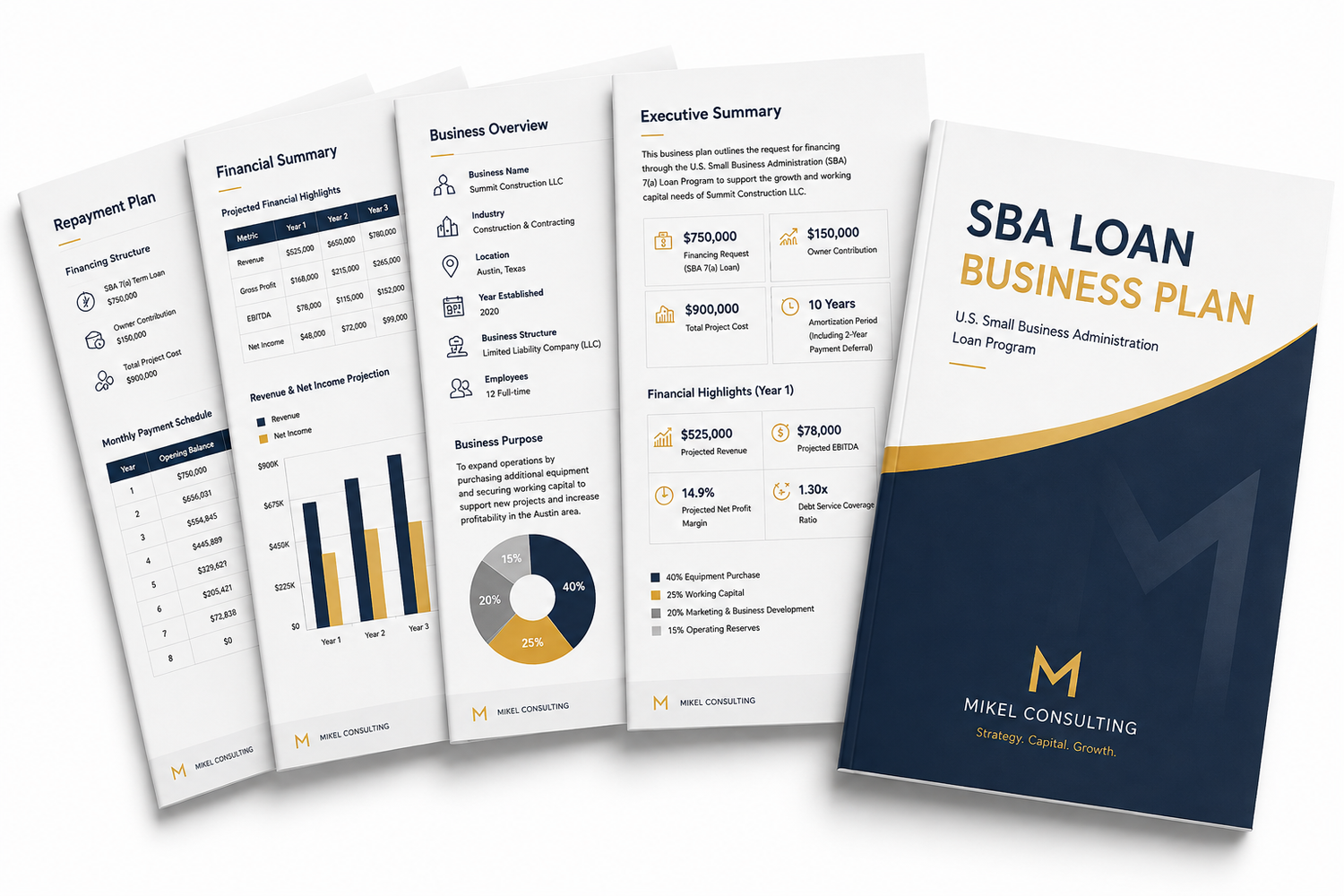
SBA business plans can include written strategy, U.S. market research, loan request details, use of funds, repayment-focused financial projections, charts, lender-ready formatting, and a clear presentation of the business case for financing.
Our Process
How Our SBA Business Plan Process Works
Intro Call or Email
We discuss your business, SBA loan purpose, lender needs, and timeline.
Engagement
You receive a contract, make payment, and complete the SBA intake form.
Information Review
We review your business, use of funds, loan objectives, and financial inputs.
Plan Drafted
We prepare the plan, funding request, use of funds, market research, and forecast.
Review & Revisions
You review the draft and we refine the document for lender review.
Final Delivery
You receive polished PDF and editable files ready for your SBA lender.
Why Mikel Consulting
Why Work With Mikel Consulting for Your SBA Business Plan?
We help U.S. small businesses prepare professional business plans that clearly present the loan request, use of funds, operating strategy, financial outlook, and repayment capacity for lender review.
SBA-Aligned Planning
We structure the plan around the business, loan purpose, use of funds, market opportunity, operating plan, and financing objectives.
Built for Lender Review
We prepare the document in a clear lender-facing format so lenders can quickly understand the business, financing request, assumptions, and repayment plan.
Clear Loan Request
We explain what the business is requesting, how the funds will be used, and why the financing is important for startup, acquisition, expansion, equipment, or working capital.
Financial Forecasting Support
We prepare projections that connect revenue, expenses, cash flow, startup costs, loan repayment, and the overall financial viability of the business.
Sample Business Plans
See What a Professional SBA Loan Business Plan Can Look Like
Business Plan Sample
Restaurant Concept
See how a restaurant business plan can present the concept, market opportunity, operating model, funding request, use of funds, and repayment capacity in a clear, lender-ready format.
View Sample PDF →Expansion Plan Sample
Pilates Studio
Review a studio expansion example showing how growth plans, service offerings, local demand, startup costs, and projected performance can be structured for business loan applications.
View Sample PDF →More Examples
Browse Our Sample Library
View additional sample documents, including bank loan business plans, investor plans, pitch decks, financial models, and other funding-related examples.
Browse All Examples →Client Funding Outcomes
Real Clients. Real Financing Secured.
Explore selected client outcomes where Mikel Consulting supported loan business plans, financial projections, and lender-ready materials used in successful financing processes.
Explore Mikel Consulting's Success Cases →CSBFP Business Plan Support
Let’s Build Your SBA Business Plan
Complete the form and one of our senior consultants will review your inquiry within 24 hours. For time-sensitive SBA business plan support, call or message us directly.
🔒 Your information is strictly confidential. We do not share your details with third parties.
SBA Business Plan FAQ
Frequently Asked Questions
What is an SBA loan?
SBA loans are financing programs supported by the U.S. Small Business Administration and delivered through participating lenders and intermediaries. SBA programs are designed to help eligible U.S. small businesses access financing for startup, acquisition, expansion, working capital, equipment, real estate, and other qualified business purposes.
What are the main SBA business loan programs?
The major SBA business financing programs include the 7(a) Loan Program, the CDC/504 Loan Program, and the Microloan Program. The 7(a) program supports a broad range of business financing needs, 504 financing is generally focused on major fixed assets, and Microloans provide smaller financing amounts through approved intermediary lenders.
How much financing is available through SBA loan programs?
SBA 7(a) loans are generally available up to $5 million. CDC/504 loans can provide SBA-backed financing of up to $5.5 million for qualifying projects, while SBA Microloans are available in amounts up to $50,000. The amount available to a specific borrower depends on the program, lender, project, use of funds, eligibility, and underwriting requirements.
What can an SBA loan be used for?
Eligible uses depend on the SBA program. Financing may support working capital, business acquisitions, machinery and equipment, inventory, supplies, leasehold improvements, commercial real estate, business expansion, and certain refinancing needs. Applicants should confirm program-specific eligible uses with the lender reviewing the financing request.
Do I apply directly to the SBA for a business loan?
Generally, no. SBA 7(a) loans are applied for through participating lenders, 504 financing involves Certified Development Companies and participating lenders, and SBA Microloans are provided through approved intermediary organizations. The lender or intermediary evaluates the application and determines whether the borrower meets applicable lending and SBA requirements.
Do I need a business plan for an SBA loan application?
A business plan is often important, particularly for startups, acquisitions, expansion projects, or financing requests that require the lender to understand future performance. SBA's lender readiness guidance notes that most lenders expect a business plan when an applicant is seeking startup funding. A strong plan can explain the business model, loan request, use of funds, market opportunity, financial projections, and repayment strategy.
What should be included in an SBA business plan?
An SBA business plan should typically include a company overview, ownership and management background, products or services, U.S. market analysis, customer segments, competitive positioning, marketing strategy, operating plan, staffing, financing request, detailed use of funds, revenue forecast, expense forecast, cash flow projections, and repayment considerations.
What financial details do SBA lenders look for?
Lenders may review projected revenue, gross profit, operating expenses, cash flow, startup or acquisition costs, debt obligations, repayment capacity, owner investment, and the assumptions supporting the forecast. The financial projections should clearly connect the financing request to how the business expects to operate and repay the proposed debt.
Can startups apply for SBA financing?
Yes. Eligible startups can pursue SBA-supported financing, subject to the requirements of the applicable program and participating lender. Because startups have limited operating history, lenders may place greater emphasis on the owner's background, business plan, market opportunity, startup budget, financial projections, available equity, creditworthiness, and repayment assumptions.
Can an SBA business plan also be used for other bank loans?
Yes. An SBA business plan can often be adapted for conventional bank financing, credit unions, acquisition financing, equipment loans, commercial real estate financing, and other business lending applications. The core strategy may remain similar, while the funding request, use of proceeds, financial analysis, and lender-specific details are adjusted for the financing program.
How can Mikel Consulting help with an SBA business plan?
Mikel Consulting prepares lender-ready business plans designed to support SBA financing applications. We help present the business model, loan request, use of funds, U.S. market opportunity, operating strategy, management team, and financial projections in a clear professional format so the lender can quickly understand the business and financing request.
How quickly can Mikel Consulting prepare an SBA business plan?
Most SBA business plans are completed within 5-7 business days once we have the required information. Timing can vary depending on the complexity of the business, financing request, number of revenue streams, research requirements, financial information available, and lender deadline.
Do you guarantee SBA loan approval?
No. We prepare professional business plans designed to support lender review, but we cannot guarantee financing approval. SBA-supported loans are still subject to lender underwriting, program eligibility, creditworthiness, repayment capacity, collateral requirements where applicable, and the overall risk profile of the financing request.
Can a business combine SBA 7(a) and 504 financing?
Effective July 4, 2026, qualified borrowers who secure an SBA 7(a) loan first may access up to $5 million through the 7(a) program and up to $5 million through the 504 program, providing as much as $10 million in combined SBA-backed financing. The programs serve different purposes. A 7(a) loan may support eligible working capital, acquisitions, equipment, and expansion costs, while 504 financing is generally used for qualifying major fixed assets such as owner-occupied commercial real estate and long-term machinery or equipment. The $10 million amount is a maximum, not a guaranteed approval. The borrower, ownership structure, project, repayment capacity, collateral, and uses of funds must satisfy the applicable requirements of each program and participating lender. The proposed structure should be confirmed with the 7(a) lender and Certified Development Company before preparing final projections.
Can an E-2 investor, green-card holder, or foreign national qualify for an SBA 7(a) or 504 loan?
Under SBA policy effective March 1, 2026, a business applying for SBA 7(a) or 504 financing must be 100% directly and indirectly owned by U.S. citizens or U.S. nationals whose principal residence is in the United States, its territories, or possessions. Legal permanent residents and foreign nationals cannot currently hold an ownership interest in the applicant or borrower. This means a business may qualify for an immigration pathway such as the E-2 visa while being ineligible for SBA 7(a) or 504 financing. Prospective business buyers and founders should confirm financing eligibility with an SBA-participating lender before relying on an SBA loan in a purchase agreement, business plan, or financial forecast. Other financing options may be available depending on the borrower, business and transaction. Mikel Consulting prepares business plans and financial projections but does not determine SBA or immigration eligibility.
How much does an SBA business plan cost?
Our SBA business plans start at $1,500 USD. This typically includes a professionally written business plan, U.S. market research, financial projections, use of funds analysis, and delivery in PDF and editable formats. Most SBA business plans are approximately 30-45 pages and are completed within 5-7 business days.