

Independent Project Assessment
Feasibility Study Consulting Services
Make the Decision Before You Make the Investment
Evaluate market demand, financial viability, operating requirements, and project risks before committing significant capital. Our feasibility studies provide independent analysis and clear recommendations on whether to proceed, revise the concept, or reconsider the opportunity.
Built for Investment and Go-or-No-Go Decisions
Can Include:
- Market demand and competitive assessment
- Operating, site, and resource requirements
- Financial viability, break-even, and scenario analysis
- Risk assessment and go, revise, or no-go recommendations
Feasibility Study Overview
Independent Analysis for Better Investment and Go-or-No-Go Decisions
A feasibility study evaluates whether a proposed business, project, location, expansion, or investment is practical and financially viable. It examines market demand, competition, operating requirements, capital needs, projected performance, risks, implementation considerations, and potential barriers before significant resources are committed.
Mikel Consulting Track Record
Evidence-based analysis supporting complex projects and strategic investments
Decision-Makers and Project Types Supported
Decision-Focused Analysis
Decisions a Feasibility Study Can Help You Make
Every feasibility study is structured around the specific decision you need to make. We examine the evidence, test the assumptions, and identify whether the opportunity supports moving forward, requires adjustment, or presents risks that should be reconsidered.
Launch a New Concept
Determine whether sufficient customer demand, market potential, and financial capacity exist to support a new business, product, service, or project.
Is the opportunity strong enough to launch?Expand or Add a Location
Assess whether a new location, geographic market, facility, service line, or operating expansion can achieve sustainable demand and financial performance.
Can the expansion perform successfully?Invest or Acquire
Evaluate the capital requirements, projected returns, operating assumptions, risks, and potential financial outcomes associated with an investment or acquisition.
Do the expected returns justify the investment?Proceed, Revise, or Stop
Bring the market, operational, financial, technical, and risk findings together into a clear recommendation that decision-makers can evaluate.
What course of action does the evidence support?Our role is to assess the opportunity objectively. Findings may support proceeding as planned, revising key assumptions, completing additional due diligence, or reconsidering the project before further capital is committed.
Service Details
Feasibility Study Delivery Details
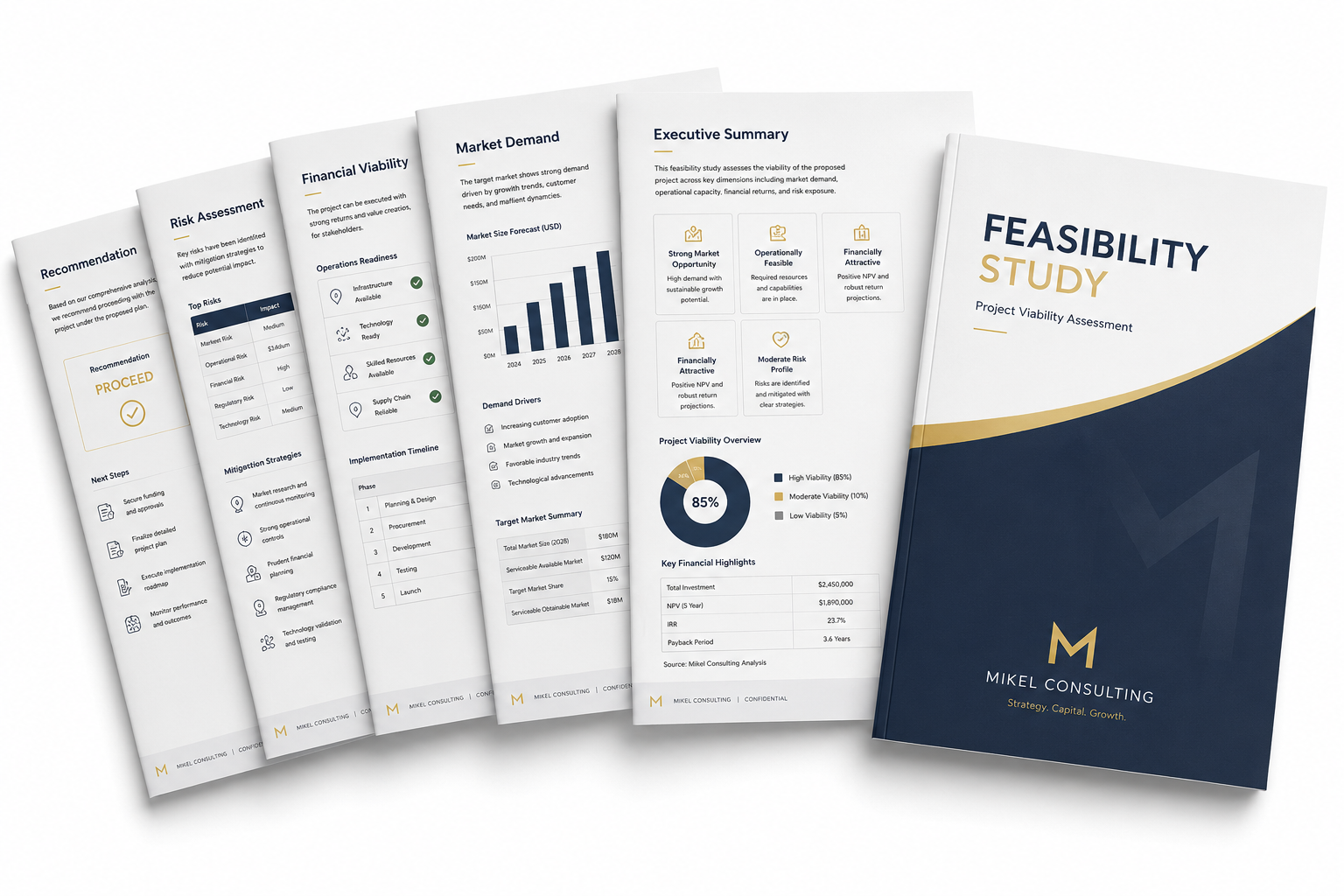
Sample Study Preview
Objective, Decision-Ready Feasibility Analysis
A feasibility study can combine market demand, competition, site or location analysis, operational and technical requirements, regulatory considerations, financial projections, break-even and scenario analysis, risks, implementation factors, and a clear go, revise, or no-go recommendation.
Our Process
How Our Feasibility Study Process Works
Objectives & Scope
We define the concept, decision to be supported, study questions, geography, and required analysis.
Engagement
You receive a proposal or contract confirming the scope, methodology, timeline, and project fee.
Data Collection
We review available documents, operating assumptions, stakeholder input, and relevant market data.
Research & Analysis
We assess demand, competition, operations, risks, financial viability, and implementation considerations.
Findings Review
We discuss the preliminary findings and refine assumptions, scenarios, and recommendations as needed.
Final Report
You receive a professional feasibility report with evidence-based findings and actionable recommendations.
Why Mikel Consulting
Why Work With Mikel Consulting for Your Feasibility Study?
We combine market research, operational analysis, financial modeling, risk assessment, and practical recommendations into one evidence-based study designed to support informed investment and project decisions.
Decision-Focused Scope
We define the questions the study must answer and structure the analysis around the actual investment, launch, expansion, location, or implementation decision.
Evidence-Based Market Analysis
We assess industry conditions, customer demand, market size, competition, location factors, comparable projects, and other evidence relevant to viability.
Operational and Financial Testing
We examine implementation requirements, capacity, staffing, costs, revenue assumptions, funding needs, cash flow, and potential financial performance.
Clear Findings and Recommendations
We bring the evidence together into practical conclusions, key risks, scenarios, and recommended next steps that decision-makers can evaluate confidently.
Sample Feasibility Study
See What a Professional Feasibility Study Can Look Like
Feasibility Study Sample
Real Estate Venture
Review a real estate feasibility study example showing how project viability, planning considerations, market assumptions, financial forecasting, and risk factors can be evaluated before moving forward.
More Examples
Browse Our Sample Library
View additional sample documents, including business plans, investor plans, pitch decks, financial models, and other funding-related examples.
Feasibility Study Support
Let’s Discuss Your Feasibility Study Services
Complete the form with the proposed project, decision to be supported, location or market, required analysis, and timeline. One of our senior consultants will review your inquiry within 24 hours. For time-sensitive studies or proposals, call or message us directly.
🔒 Your information is strictly confidential. We do not share your details with third parties.
Feasibility Study FAQ
Frequently Asked Questions About Feasibility Studies
Detailed answers about market, operational, technical, organizational, and financial feasibility; study scope; data requirements; scenarios; recommendations; timelines; and the difference between a feasibility study and business plan.
What is a feasibility study?
A feasibility study is a structured evaluation of whether a proposed business, project, expansion, facility, service, acquisition, or investment is practical and financially supportable under defined assumptions. It examines the evidence required to answer a decision, such as whether sufficient demand exists, whether the operating model can be implemented, how much capital is required, and what risks could prevent success.
The study should do more than describe an attractive idea. It tests the concept against market conditions, competition, location, customers, capacity, staffing, regulation, implementation requirements, costs, revenue potential, cash flow, and alternative scenarios.
When should a feasibility study be completed?
A feasibility study is useful before committing substantial capital, signing a long-term lease, purchasing land or equipment, acquiring a company, entering a new market, developing a facility, launching a new service, or seeking approval from a board, lender, investor, government agency, or funding partner. It is most valuable while decision-makers can still change the project.
Organizations also use feasibility studies when stakeholders disagree about assumptions or when a project requires evidence beyond management enthusiasm. The study can identify information gaps, compare options, define conditions for success, and show whether the concept should proceed, be modified, be phased, or be reconsidered.
What questions can a feasibility study answer?
The questions depend on the decision. Common examples include: Is there enough customer demand? Which location or service model is most suitable? What price and volume are required? What facilities, equipment, staff, technology, licenses, partnerships, or suppliers are needed? How much capital and working capital will the project require? When could it break even? Which assumptions have the greatest effect on viability? What risks and implementation barriers must be addressed?
A strong scope defines the questions before research begins. This prevents the study from becoming a broad information report that contains interesting facts but does not support the actual decision.
What is included in market feasibility analysis?
Market feasibility can include industry conditions, market size, growth trends, customer or beneficiary segments, demographics, purchasing behavior, demand indicators, competitor and substitute analysis, pricing, geographic reach, site factors, channel access, stakeholder input, and comparable projects. The analysis should connect broad market evidence to the specific concept and location.
Published statistics alone rarely prove feasibility. We consider whether the proposed business can realistically reach the target customer, compete for demand, deliver the required value, and achieve the projected volume. Where appropriate, primary research such as interviews, surveys, consultations, or customer data can supplement secondary sources.
What does operational or technical feasibility examine?
Operational feasibility tests whether the organization can deliver the proposed product or service. It may examine facilities, equipment, technology, production or service capacity, workflow, staffing, management, suppliers, logistics, quality control, maintenance, implementation timing, partnerships, permits, regulations, accessibility, and other delivery requirements.
Technical depth depends on the project and available expertise. Mikel Consulting can assess business and operating requirements, but specialized engineering, architectural, environmental, legal, clinical, technology-security, or regulatory conclusions may require qualified third-party professionals. Those specialist findings can be incorporated into the broader feasibility analysis.
What is included in financial feasibility?
Financial feasibility estimates the capital required to launch or complete the project and tests whether expected revenue, funding, cost savings, or other benefits can support operating expenses, debt, reinvestment, and required returns. The analysis may include startup costs, sources of funds, revenue drivers, staffing, operating expenses, capital expenditures, working capital, cash flow, break-even, debt service, profitability, and scenario analysis.
The objective is not simply to produce a profitable forecast. It is to determine which assumptions must be true, when cash may be constrained, how much contingency is required, and whether the organization has a credible path to finance and operate the project.
Can the study compare options and test different scenarios?
Yes. Many studies are more useful when they compare alternative locations, facility sizes, service models, pricing approaches, ownership structures, implementation phases, technologies, or financing packages. A common framework includes a base case, downside case, upside case, and one or more strategic alternatives.
Scenario testing helps decision-makers understand which variables matter most. For example, the study may test slower customer adoption, higher construction costs, lower utilization, delayed opening, different staffing levels, or phased capital investment. The goal is to expose sensitivity and decision thresholds rather than hide uncertainty behind one forecast.
How is a feasibility study different from a business plan?
A feasibility study evaluates whether a proposed project should proceed and under what conditions. It is analytical and should be willing to identify weaknesses, alternatives, or a conclusion that the current concept is not yet supportable. A business plan explains how management intends to execute a selected strategy and is generally written after the fundamental direction has been chosen.
Some research and financial modeling may be shared, but the documents answer different questions. Feasibility asks, 'Is this practical and viable?' A business plan asks, 'How will we launch, operate, finance, and grow it?' A feasibility study may therefore become an important input into a later business plan.
What information, timeline, and budget are required?
We request the concept, decision to be supported, proposed location or market, existing reports, stakeholder information, operating assumptions, technical studies, cost estimates, pricing, demand evidence, historical data, financial information, funding constraints, and the questions decision-makers need answered. The scope may also identify interviews, surveys, site visits, workshops, or specialist input.
Timeline and price depend on the number of research questions, geographic scope, primary research, data availability, financial-model complexity, number of options, stakeholder engagement, and report requirements. A focused private-sector study may take weeks; a regional, public, technical, or multi-stakeholder assignment may require several months.
Does a feasibility study guarantee that the project will succeed?
No. A feasibility study is based on available evidence and stated assumptions at the time of analysis. Actual results can differ because of execution, management, financing, construction, regulation, customer behavior, competition, costs, economic conditions, technology, or unexpected events. The report reduces uncertainty; it does not eliminate risk.
Mikel Consulting presents the evidence, assumptions, sensitivities, risks, and conclusions supported by the agreed scope. Decision-makers remain responsible for the final investment or implementation decision and should obtain specialized legal, engineering, environmental, accounting, tax, valuation, or regulatory advice when the project requires it.