

U.S. Restaurant Business Planning
Restaurant Business Plan Services
Custom plans for restaurants, cafés, food trucks, franchises, bars, bakeries, and hospitality concepts.
We prepare restaurant business plans for SBA and conventional loans, private investors, landlord approval, equipment financing, immigration applications, and expansion. Each plan connects the concept, menu and pricing, location, customer demand, staffing, startup budget, and projected financial performance.
A Plan That Connects Your Concept, Location, Funding, and Financial Case
Can Include:
- Concept, menu, pricing, seating, and revenue streams
- Location, customer demand, competition, and positioning
- Staffing, food costs, operating systems, and capacity
- Startup budget, break-even analysis, and five-year projections
Restaurant Business Plan Overview
Business Plans That Connect Concept, Location, Operations, and Restaurant Economics
A restaurant business plan explains the concept, menu, price point, customer, location, service format, sales channels, staffing, suppliers, equipment, marketing, startup or acquisition costs, and projected financial performance. It gives lenders, investors, landlords, and partners a coherent view of how the restaurant will open, attract customers, and manage margins.
Mikel Consulting Track Record
Supporting restaurant operators preparing to secure financing, locations, investors, and growth capital
Food Businesses Supported
Food Businesses We Support
Restaurant and Food-Service Business Types We Support
Full-Service Restaurants
A restaurant business plan for table-service concepts covering cuisine, menu, seating, average checks, table turns, reservations, kitchen capacity, staffing, alcohol, and customer experience.
Quick-Service Restaurants
A quick-service restaurant business plan for counter-service, fast-casual, takeout-heavy, drive-through, high-volume, franchise, and streamlined kitchen concepts.
Cafés & Coffee Shops
A café business plan covering coffee, beverages, baked goods, light meals, seating, transactions, dayparts, customer frequency, equipment, retail products, and neighborhood demand.
Food Trucks & Mobile Kitchens
A food truck business plan for mobile locations, events, commissary kitchens, permits, vehicle and equipment costs, menu capacity, catering, scheduling, and seasonal sales.
Bars, Lounges & Nightlife
A bar business plan covering beverages, food, entertainment, seating, peak hours, events, security, inventory controls, licensing assumptions, staffing, and nightlife marketing.
Bakeries & Dessert Concepts
A bakery business plan for retail and wholesale baked goods, custom cakes, desserts, production capacity, ingredients, equipment, display space, preorders, and seasonal demand.
Ghost Kitchens & Delivery Concepts
A ghost kitchen business plan for delivery-first brands, shared kitchens, online ordering, platform fees, packaging, multiple menus, kitchen capacity, and digital customer acquisition.
Restaurant Franchises & Acquisitions
A restaurant acquisition or franchise business plan incorporating brand requirements, purchase price, franchise fees, historical sales, location, renovation, financing, and transition strategy.
Business Plan Content
What Your Restaurant Business Plan Includes
Each plan is customized to your concept, location, funding purpose and operating strategy.
Market & Competitive Analysis
Local dining demand, demographics, foot traffic and spending patterns, together with an assessment of competing restaurant concepts.
Business Model & Menu
Dine-in, takeout, delivery, catering, events and beverage revenue, including menu prices, check averages and food costs.
Restaurant Operations
Kitchen workflow, service standards, purchasing, inventory, food safety, scheduling and supplier relationships.
Marketing Strategy
Opening campaigns, social media, local search, delivery platforms, partnerships, loyalty programs and repeat visits.
Management & Staffing
General management, chefs, kitchen employees, servers, hosts, bartenders and support roles.
Financial Plan & Implementation
Covers, table turns, check averages, food and labor costs, buildout funding and opening milestones.
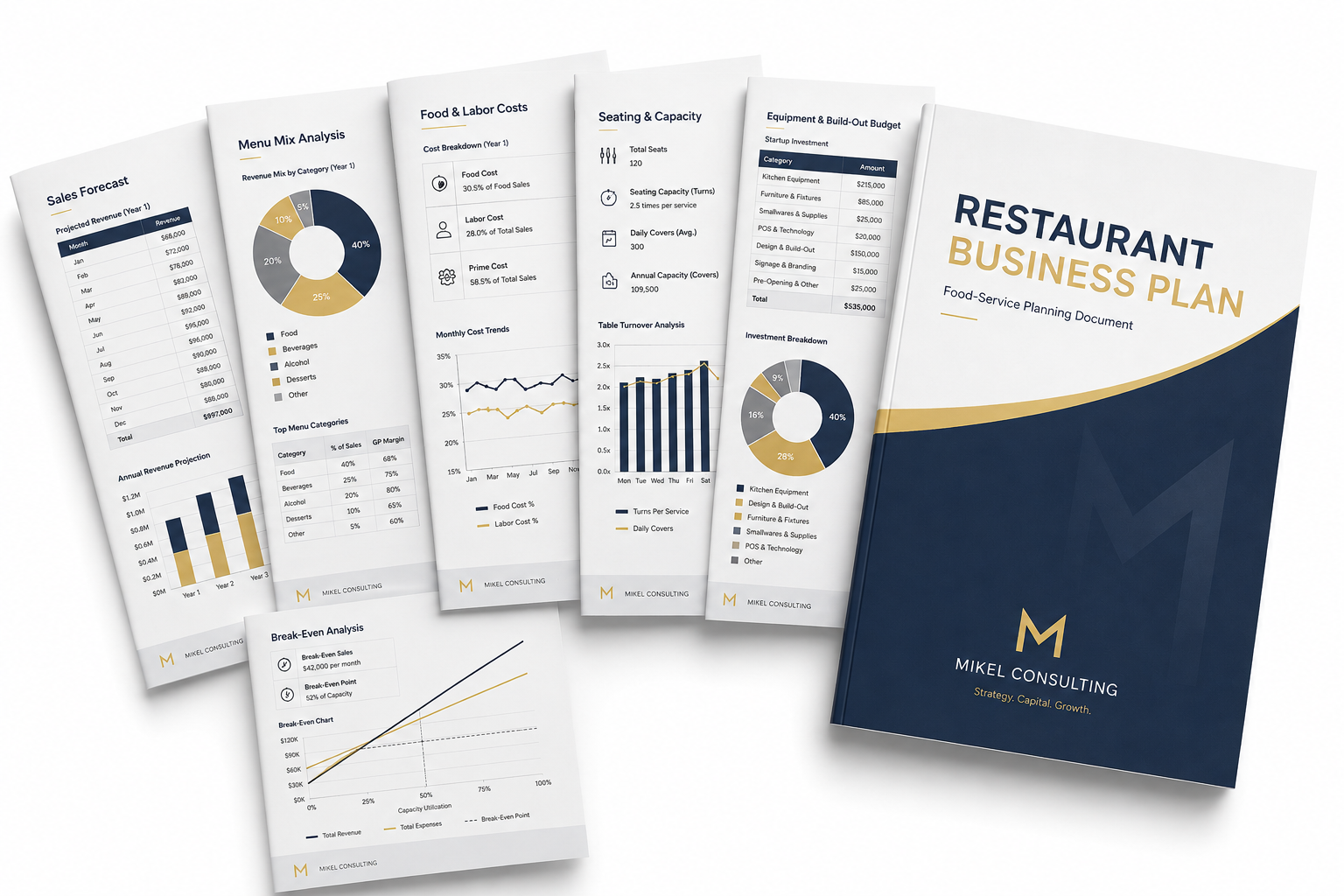
Sample Restaurant Plan Preview
Professional, Decision-Ready Formatting
Your restaurant business plan converts the concept, menu and guest experience into a realistic operating and financial roadmap.
Funding and Planning Uses
Restaurant Business Plans for Bank Loans, Investors and Immigration
A restaurant business plan can support a bank or SBA loan, investor discussions, immigration applications, a restaurant acquisition or decisions about a new concept, location or expansion.
Bank Loan Business Plans
Support financing for restaurant equipment, leasehold improvements, furniture, opening inventory, marketing, working capital or an acquisition.
Explore Bank Loan Plans For SBA FinancingSBA Loan Business Plans
Prepare an SBA 7(a) or 504 plan for a restaurant startup, acquisition, franchise, major renovation, equipment purchase or owner-occupied property.
Explore SBA Loan Plans For Equity CapitalInvestor Business Plans
Present the concept, menu, customer experience, location strategy, funding requirement, unit economics and opportunity for expansion.
Explore Investor Plans For Visa ApplicationsImmigration Business Plans
Document the restaurant investment, ownership structure, operating model, owner’s role, hiring plan and expected U.S. business growth.
Explore Immigration Plans For ForecastingFinancial Modeling
Forecast guest counts, average checks, table turns, takeout sales, food costs, labor, occupancy expenses, break-even sales and cash flow.
Explore Financial Models For Location DecisionsFeasibility Studies
Evaluate customer demand, competition, site visibility, traffic, pricing, operating costs, concept positioning and projected financial viability.
Explore Feasibility StudiesRestaurant Business Plan Guide
How to Write a Restaurant Business Plan That Supports Financing and Launch
A strong restaurant business plan should connect the concept, target customer, location, menu economics, operating capacity and funding request in one realistic launch strategy.
Define the Restaurant Concept
Explain the cuisine, service model, atmosphere, price point and target customer. Clarify whether revenue will come from dine-in service, takeout, delivery, catering, alcohol or private events.
Research the Market and Location
Analyze local demographics, dining demand, foot traffic, daytime population and spending. Compare nearby restaurants based on concept, menu, prices, reviews and customer experience.
Build the Menu and Pricing Model
Define menu categories, prices, ingredient costs, beverage margins and expected sales mix. Calculate realistic gross margins and identify the items expected to drive sales.
Develop the Operating and Staffing Plan
Explain kitchen workflow, purchasing, inventory, food safety and customer service. Identify management, chefs, kitchen staff, servers, hosts and support positions.
Create the Marketing and Launch Strategy
Describe pre-opening promotion, local search, social media, delivery platforms, community partnerships and loyalty programs. Include a realistic soft-opening and customer-acquisition plan.
Prepare Financial and Funding Projections
Forecast covers, table turns, check averages, food costs, labor, occupancy expenses and cash flow. Connect financing to buildout, equipment, inventory, licenses and working capital.
Our Process
How Our Restaurant Business Plan Process Works
Discovery
We review your restaurant concept, menu, service model, location and funding purpose.
Engagement
You receive a contract, make payment and complete our structured intake questionnaire.
Information Review
We review your menu, pricing, seating, equipment, suppliers and staffing assumptions.
Research & Financials
We assess local dining demand and model covers, check averages, food costs and payroll.
Draft & Revisions
You review the draft and we refine the plan for accuracy, clarity and funding readiness.
Final Delivery
You receive polished PDF and editable files ready for your intended audience.
Why Mikel Consulting
Why Work With Mikel Consulting for Your Restaurant Business Plan?
We combine restaurant market research, concept strategy and detailed financial forecasting into a professional plan built around your menu, location and funding objectives.
Restaurant Market Research
We assess local dining demand, demographics, foot traffic, spending patterns, industry trends and competing restaurants.
Concept-Specific Strategy
We clearly present your menu, pricing, service model, location, guest experience, marketing and operating approach.
Integrated Financial Projections
Our forecasts connect covers, table turns, check averages, food costs, labor, occupancy expenses, financing and cash flow.
Senior Consultant Involvement
Your plan is developed and reviewed by experienced consultants who understand hospitality operations, financing and launch planning.
Restaurant Business Plan Examples
Explore Bank Loan and Investor Business Plan Examples
Review a restaurant bank loan business plan example alongside an investor plan to compare how financing requests, market opportunities and financial projections are presented.
Restaurant Bank Loan Plan Example
Full-Service Restaurant
Review how a restaurant presents its loan request, use of funds, concept, market analysis, operating plan and repayment-focused financial projections.
Investor Business Plan Example
Environmental Consulting
See how a growth-stage company presents its market opportunity, expansion strategy, funding request and investor-facing financial projections.
More Business Plan Examples
Browse Our Sample Library
Explore additional business plans, financial models, feasibility studies and other professional planning documents.
Restaurant Business Plan Support
Let’s Discuss Your Restaurant Business Plan
Complete the form with your restaurant concept, menu and service format, proposed location, startup or acquisition plans, financing request, and deadline. One of our senior consultants will review your inquiry within 24 hours. For a time-sensitive loan, lease, or investor opportunity, call or message us directly.
🔒 Your information is strictly confidential. We do not share your details with third parties.
Restaurant Business Plan FAQ
Frequently Asked Questions About Restaurant Business Plans
What should a restaurant business plan include?
A restaurant business plan should explain the concept, cuisine, menu, price point, service model, target customers, location, seating, hours, sales channels, staffing, suppliers, equipment, marketing, management, and opening strategy. It should distinguish dine-in, takeout, delivery, catering, events, alcohol, retail products, food-truck, ghost-kitchen, or franchise revenue where relevant.
The financial section should connect transactions, average checks, seats, table turns, channel mix, food and beverage costs, labor, occupancy expenses, startup capital, and cash flow.
Can a restaurant business plan support an SBA loan or investor presentation?
Yes. A lender-ready plan can support SBA-backed or conventional financing for a startup, acquisition, franchise, equipment, renovation, working capital, or expansion. An investor-oriented plan can explain the concept, market opportunity, operating team, capital requirement, ownership proposal, growth strategy, and expected financial outcomes.
The same research and financial model can support both audiences, but the funding narrative should be tailored. Lenders focus heavily on repayment and owner contribution, while investors may place greater emphasis on scalability, returns, governance, and exit possibilities.
How should restaurant sales be forecast?
Sales should be built from operational drivers such as seats, table turns, transactions, average checks, dayparts, operating days, takeout and delivery orders, catering events, and ramp-up. The mix should reflect the concept and location rather than relying on an unsupported annual sales estimate.
Capacity is only a ceiling. The forecast should consider customer demand, weekday and weekend patterns, seasonality, reservations, kitchen throughput, delivery-channel economics, and the time required to build awareness and repeat business.
How are food, beverage, and labor costs modeled?
Food and beverage costs should reflect the menu mix, ingredient costs, portioning, waste, discounts, complimentary items, packaging, and supplier pricing. Labor should be built from management, kitchen, service, bar, delivery, cleaning, and administrative schedules, including payroll-related costs.
The plan should show how pricing, purchasing, menu engineering, scheduling, and sales volume affect prime costs and profitability. Using one generic percentage without checking the concept can hide important risks.
How important are the location and lease to the business plan?
The plan should examine visibility, access, parking, traffic generators, nearby residents and workers, competition, delivery demand, zoning, the physical condition of the space, and whether the site supports the kitchen, seating, utilities, ventilation, and licensing needs. Lease economics should be tested against projected sales.
A low base rent can still be expensive if major construction is required, while a higher-rent second-generation restaurant may reduce equipment and build-out costs. The full occupancy and development budget should be evaluated together.
What financial projections should a restaurant plan contain?
A restaurant model may include monthly first-year and annual multi-year income statements, cash flow, balance sheets, break-even analysis, startup budget, sources and uses, and schedules for sales, food costs, labor, operating expenses, capital expenditures, and financing. The forecast should allow for pre-opening costs and an operating ramp-up.
For an acquisition or expansion, historical sales and margins should be reconciled with changes in hours, menu, pricing, seating, delivery, staffing, rent, and debt.
What are common weaknesses in a restaurant business plan?
Common weaknesses include forecasting full sales from opening, underestimating construction and permitting, omitting pre-opening payroll and working capital, understating food or labor costs, and assuming delivery revenue has the same margin as direct sales. Other issues include a menu that does not fit the equipment, staffing that does not fit the hours, and rent that is not supportable by projected sales.
A credible plan connects the concept, menu, location, service capacity, staffing, startup budget, sales assumptions, and cash flow.
What information does Mikel Consulting need to prepare a restaurant business plan?
We typically request information about your concept, menu, pricing, service format, proposed location, seating, operating hours, sales channels, owner and chef experience, staffing, suppliers, equipment, licensing status, startup or acquisition budget, owner contribution, financing request, and any historical sales or financial statements. The exact list depends on whether the project involves a startup, acquisition, expansion, financing request, investor presentation, licensing process, or internal planning.
Not every decision must be final before work begins. Our intake process helps identify gaps, and reasonable assumptions can be developed where information is still being confirmed. The client remains responsible for verifying ownership, legal, regulatory, transaction, and financial information before the plan is submitted or relied upon.
How long does a restaurant business plan take, and what does it cost?
Our U.S. restaurant business plans currently start at $1,000 USD. A typical first draft is delivered within 7 to 10 business days after we receive the required information. More complex developments, acquisitions, multi-location operations, specialized research, extensive financial cleanup, or urgent deadlines may require a custom scope, price, and schedule.
The service includes research, written strategy, financial projections, professional formatting, and revision support for 30 days after the first draft. Final delivery can include a polished PDF and editable working files.
Can a professionally prepared restaurant business plan guarantee financing or approval?
No. A professional plan can improve how the business, market opportunity, operating strategy, funding requirement, and financial projections are presented, but it cannot guarantee a decision by a lender, investor, landlord, franchise partner, licensing professional, or other reviewer. Outcomes depend on the complete application, applicant qualifications, credit and financial position, available capital, collateral where relevant, regulatory eligibility, market conditions, and the reviewer’s independent criteria.
Mikel Consulting’s role is to develop a credible, internally consistent plan, identify unsupported assumptions, and communicate the business case clearly. The relevant lender, investor, agency, landlord, or other decision-maker remains solely responsible for its review and decision.